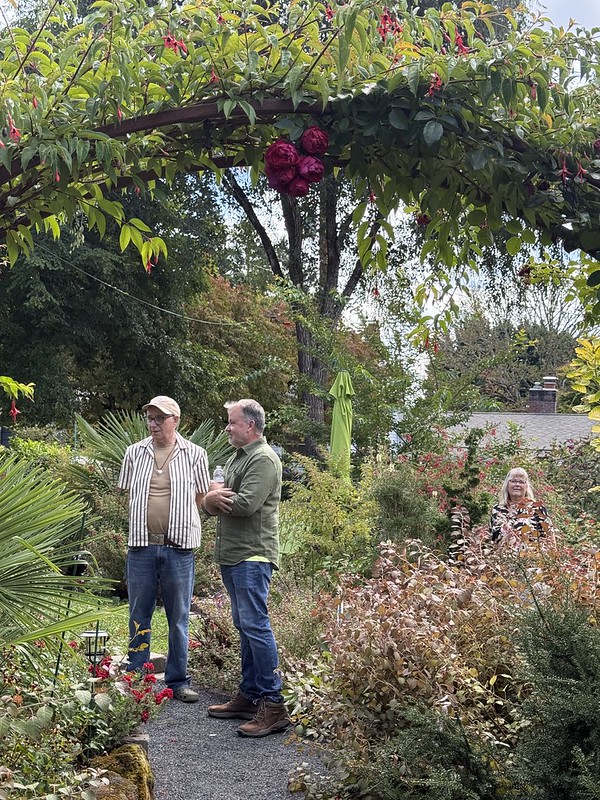
Theo Margelony moved with his fuchsias from Manhattan to Portland in 2019. Knowledgeable, warm and very friendly, I have bumped into Theo and his partner Kevin Gepford a couple times on garden tours. Knowing there’d be a warm welcome at their open garden in early September, it was that more than an interest in fuchsias that prompted me to attend.

I’ve grown a few hardy fuchsias in my time but otherwise haven’t explored the genus much. But I am completely open to plants with a long season and something to offer hummingbirds. Hummingbirds currently are lured by phygelius and Lobelia tupa in my Oregon garden late September, but some backup would be nice. In the Los Angeles garden grevilleas and aloes handle the job year-round, and it’s in that garden that I became a fan of the equivalent of having your own private troupe of tiny circus acrobats perform multiple times a day. In a small garden, I think it’s fair that where my plant interests and aesthetics converge with supporting wildlife, we can collaborate, whether the needs are shelter, pollen, nectar, seedheads. And surprisingly our interests as far as plant choices converge quite a bit.

As cutback shrubs, and/or spared a hard winter, hardy fuchsias can make great size in summer, with nectar available at least July to frost. And with warmer winters, possibly even longer. Theo’s garden had more examples than seemed possible for a Portland city garden.
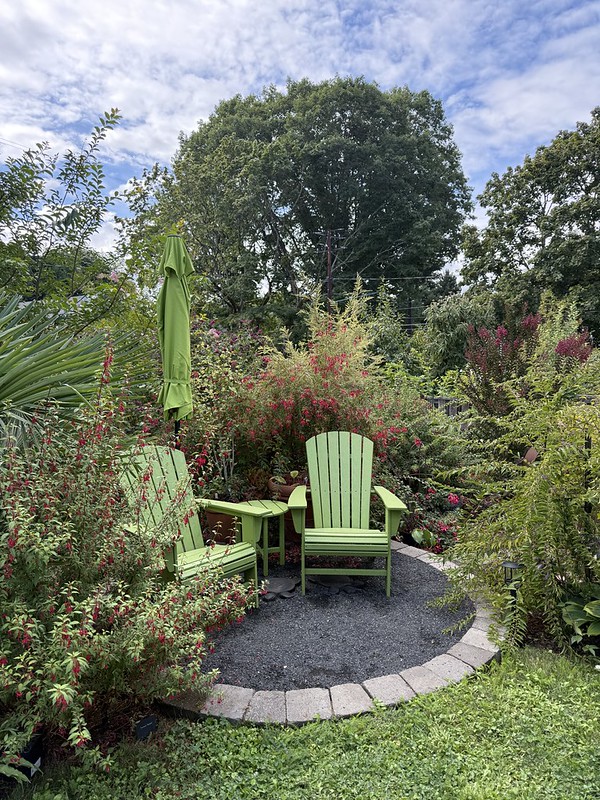

With over 200 hardy magellanica cultivars in Theo’s garden, September never looked so fresh, and with plenty of steam left to roll til frost. For a fuchsia devotee, the PNW is the place to be.

The Fuchsietum makes the case that fuchsias can share space with and complement all kinds of plants. Palms, perennials, abutilons, crepe myrtles, daphnes. And even though fuchsias are an obvious favorite, the garden wastes no time waiting for their summer arrival. Theo says it’s bustling with incidents and successive schemes starting with the early bulbs of spring, whose leaves are now buried under the skirts of fuchsias.


The enthusiasm for plants surrounds the house on all sides.


I’m guessing full sun here at the coast, zone 8-9. Some hardy fuchsias are supposedly root-hardy to zone 7 and possibly even zone 6 (‘Riccartonii.’) I should be able to fit in at least one of these exceptionally long-blooming shrubs for my hummingbird friends. Thank you, Theo, for the recommendations! More soon, AGO

I know so little about fuchsias. 200 hardy cultivars in one garden, that bowled me over.
But were there any agaves? That’s my big burning question!
@Gerhard, an agave didn’t jump out at me, but I wouldn’t be surprised if there were a few. Theo’s plant interests are very eclectic. And I made a note when he said 200 kinds — I would never have trusted memory with that number!
If only fuchsias did as well here! I had more in my former garden but I’ve all but given up on them in my current location. Even our local botanic garden’s fuchsia garden is pitiful by comparison to this one.
Wow! Theo and Kevin’s garden has exploded since I was last there (just after the greenhouse went up?). Theo has certainly helped to spread the gospel of the fuchsia here in Portland.
@Kris, I’ve grown the magellanica types in SoCal and they did fine, just not making the gorgeous happy shrubs like in Theo’s garden. I never attempted the fancier “nonhardy” types but remember childhood neighbors growing them.
@Loree, I remember meeting up at their house for a plant exchange before the greenhouse and it’s a different garden now, looking very established.
I’m always a fan of gardens full of pathways and no grass. His name is fun to say, but woah his bio is super impressive!
The last time I was there was pre-greenhouse and most of his fuchsias were in pots. A lot has changed since then. That was my first garden blogger meet-up!
Oh to be able to grow so many gorgeous fuchsias to such size. Growing up in the PNW they were ubiquitous but living now where they aren’t hardy I collect small pots, grow them on but have to bring them in for the winter. They are tough and forgiving plants that offer so much.
@Tracy, if you get a chance on a garden tour, sit next to these two on the bus — they’re a lot of fun.
@Jerry, I think I was there, a plant swap? I had no idea that was your first.
@Elaine, I’m trying a few fall-planted magellanica types. I don’t have the means to overwinter any indoors but sounds like they’re well suited to this treatment.