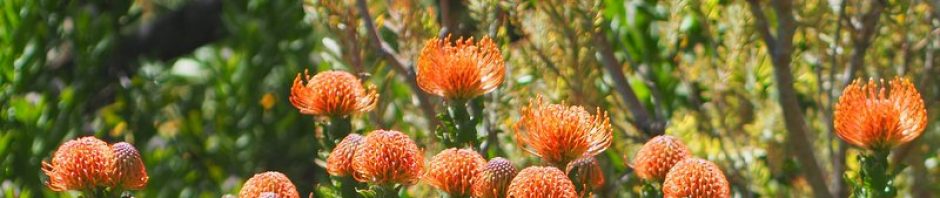

Within a day or two before leaving the Long Beach garden last spring, Grevillea ‘Moonlight’ sheared off an enormous middle branch, violently bifurcating that luminous, stately canopy into goofy ears. The tear was rough and I assumed possibly fatal, but there was no time to address the disaster — or solution really. This February has produced a mighty flush of flowers on a 12-foot, V-shaped tree, so the solution appears to be to leave it alone for now. It is a fast-growing shrub/small tree in constant bloom that I would immediately replace if lost entirely.

For wildlife, this grevillea is the mainstay of the garden, whatever its awkward shape. With the aloes covering about two months of blooms, December and January, the kangaroo paws now taking up the baton and fattening up long-lasting flower spikes for early spring, I feel the garden is in good hands whether I’m home or away. Did I choose these plants for their wildlife benefits? Honestly, no. I chose them for their beauty and low-water use. As the garden continues its self-editing process while I’m away half the year, I never know what to expect. Many other plants I chose were either too rampant (passiflora) or unsuitable for a summer-dry garden (melianthus). I’ve got a makeshift roster of friends and neighbors who help to water containers (so they say!), but the garden itself gets no deep watering for the months I’m away.
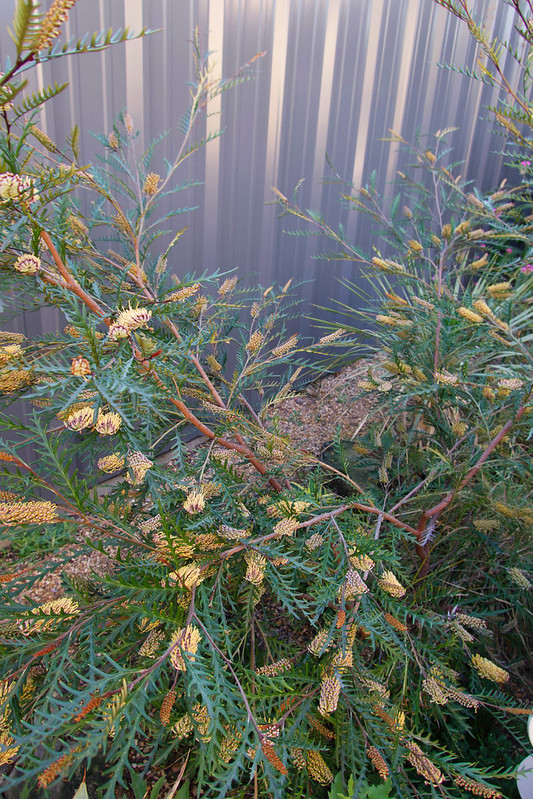
Not all grevilleas have proven as resilient as ‘Moonlight.’ To be fair, ‘Poorinda Blondie’ was newly planted in November 2020, and I left the garden on its own October 2021. By October 2024, ‘Poorinda Blondie’ had collapsed.

The sonchus are budding up, and there’s no question that a giant dandelion will be the life of the party when in bloom. It’s become a regular presence through the years, robustly reseeding despite most references suggesting Sonchus palmensis does not reseed — wtf? Geranium maderense also reseeds luxuriantly, thinned to five plants that should bloom maybe by March. (Being biennial, I think this year it should cycle into flower but no guaranties.) Seedling poppies and orlaya are entrenched in the garden too for early summer, a show I mostly miss but know by their ghostly skeletons I pull out in fall. And the tall pencil plant, Pedilanthus bracteatus, is another year-round source of nectar for hummingbirds. When I’m home, I see these guys every day and can’t help but feel responsible for them!
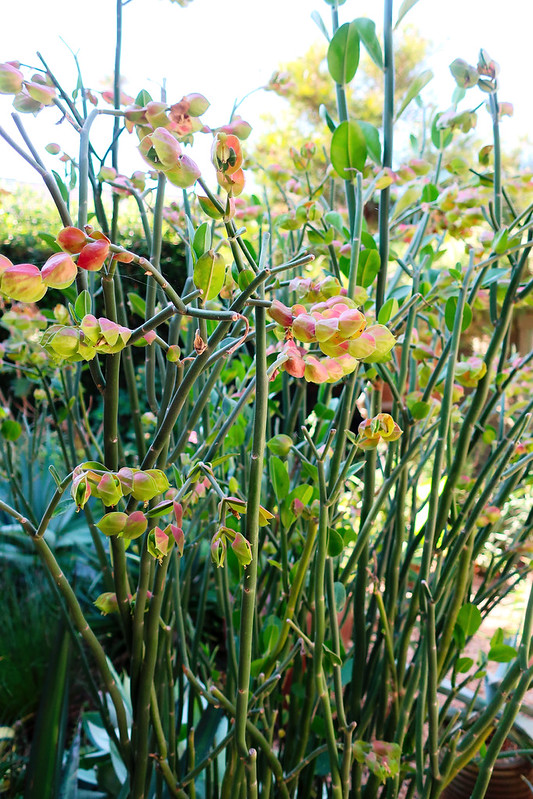

So a garden that looks like all leaves, all the time, has a few tricks up its sleeve.


Other tough plants that survive without much attention are the false bromeliad, Callisia fragrans, interplanted here with an early prototype mangave that pups efffusively. Threading through the strappy leaves are self-sown Aristolochia fimbriata. All three would happily cover yards of the garden if allowed.


88F predicted for today then hopefully cooler later in the week. Take care, AGO
It is amazing, and a credit to the gardener, how well your garden does when you are gone for such long periods of time. Also a bit of a science experiment to determine the toughest of plants. Love that dyckia. The dark green with the silvery thorns create a kind of glow. Think of the grevillea as a shrub with ‘character’ now than it won’t seem so awkward.
@Elaine, it’s a different kind of gardening, for sure. I look at old pictures and don’t always find the contrast favorable! Thanks for the encouragement.
Your garden looks great, Denise! I’d be thrilled if my own Grevillea ‘Moonlight’ flowered half as well as yours with all its branches intact – I usually don’t get more than a handful of blooms from it. But then my Grevillea ‘Superb’ makes up for ‘Moonlight’s’ performance. I’ve yet to see Orlaya self-seed, much less poppies, although it looks as though a few California poppies seeded here and there in the raised planters of my cutting garden 😉 I chop my Sonchus down (a gift from you some years ago) each year when it finishes blooming and it returns bigger every time but I’ve yet to see seedlings (for which I’m thankful).
@Kris, that is so funny about your ‘Moonlight’ and also the sonchus and orlaya not reseeding in your garden — which proves that trial and error seems to be the best way forward because general garden advice just can’t cover all the contingencies, even for the same zone!
Excited to see your ‘Moonlight’ grevillea (however oddly shaped) as we recently added one to the Los Osos garden. The few pale flowers it’s pushing out are attracting hummers already – they know a good deal! Also loving your G. ‘Poorinda Blondie’ – I’m off to see how it would do in Astoria…
@Jane, so exciting to hear of your new garden taking shape — you’ve got a lot of good nurseries up your way! Australian Plants (and the Taft) are not too far for you. I wonder what Poorinda B would think of Astoria. I played it safe and planted the bottlebrush’Wetlands Challenged Mutant’ in Tillamook…
88°!!! No wonder your garden is so ahead of mine. That Dyckia is freaking perfection. I have a young Grevillea ‘moonlight’ and can’t wait for it to be as stately as yours. V or not, it’s gorgeous.
@Tracy, before the break ‘Moonlight’ was really something. Maybe more attention to pruning would have helped. I love dyckias and had a massive clump in the front garden but they are such bastards to deal with in the ground — pots are the way forward for me.
This post (and the last) have me admiring all the foliage in your CA garden – youg’ve got some very interesting leaf shapes and colors going on. I was astounded by the dyckia. Even though I have a couple in pots, I dread the day I need to do anything with them. I don’t think I’ve ever had a plant that could razor my flesh open from 5 feet away like a dyckia can. How’s the tailbone?
@Jerry, dyckias are the scariest! X-ray showed nothing broken which helped me be a little more aggressive with an active recovery!