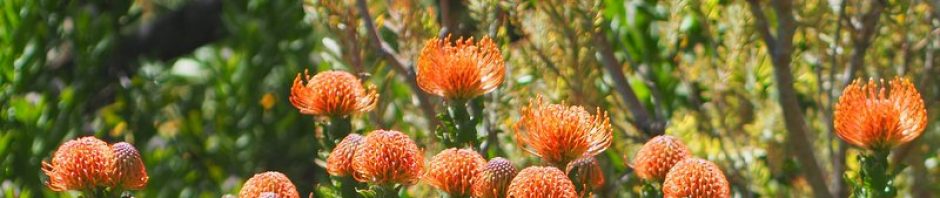

Monday morning dawned fresh and cool with a minor epiphany. Stepping out the backdoor, the opening of the first poppy scrambles a sleepy brain with the sensation of a delicate jellyfish floating over the garden (upside down).

This week’s West Coast heat wave has been written up in all the national newspapers. Yesterday, taking in our nightly PBS Newshour, we were dumbfounded to be looking at our local park on the newscast, near the beach where Marty runs, with locals being interviewed on how hot it’s been. As much as 35 degrees above normal for this time of year, is how hot it’s been.

Monday wasn’t too bad, with a lovely scrim of morning fog, then reaching mid 80sF in the afternoon. Tuesday soared to a stupor-inducing 99F. *Wednesday is predicted to stay in the 80sF here at the coast and through the week. (*Edited to add: W-F reached 90F here at the coast.)

With the garden set to return to autopilot when we leave in a few weeks, it’s time to get the final tweaks in as far as best chances for survival. Emergency moves included a large clump of pyrrosia that was poorly sited and getting burned by some sneaky shafts of sunlight penetrating the grevillea’s canopy. Neighbors have promised to check in and water the pots.

A couple weeks ago the Garden Conservancy put out a request for volunteer docents for their Palm Springs Open Days this Saturday. What a great day trip! Checking the forecast, I was dumbfounded that it could get that hot in March. Regretfully, no way. Not a good look when the docent passes out in the garden.


A box of plants arrived Monday from High Country Gardens, impeccably packed and on time, most destined for the Oregon garden (intriguing Verbascum ‘Letitia’). I built the order around the only source I could find for sideritis, plants I really miss having in the garden. I’m hoping these two Sideritis syriacus reseed, as it has in the past. With the forecast showing cooling at the coast, these were planted this morning.


There’s been more activity at the far boundary wall since Bilbergia ‘Hallelujah’ was introduced there.


Other shady characters are on the move to the cool back wall too, including more bromeliads and a few ferns, Blechnum gibbum ‘Silver Lady,’ Asplenium bulbifera and Pleopeltis lepidopteris. The latter tolerates dry conditions very well, not sure about the other two…


What I’ve been calling couch grass has been identified by a landscape restorationist neighbor as African Veldt Grass. It is a fairly recent menace and of the very worst kind. Ehrharta erecta (annual) and Ehrharta calycina (perennial) are both perpetually in seed spread by birds, wind, shoes, etc. One of my short-lived theories accounting for its vigorous presence in the garden was that the generous spacing around plants now that I’m not here full time allowed in more weeds. There was rarely bare soil showing when I gardened year-round. But this nasty weed penetrates the densest clumps of sesleria and tulbaghia and sneaks in under the rosettes of large succulents. It infests the entire neighborhood now and needs constant vigilance to control. I really don’t recall it in the garden prior to 2020. My neighbor used Fusilade when eradicating this weed from acres of native plant communities.

Take care! More soon, AGO
Ha ha, Billie is full of joy. I couldn’t remember when you trek back, before it gets hot…. except not this year with the heat wave. I love how brazen you are, planting things and not able to check on their wellbeing for months. That ‘Creme Brulee’ is unreal, an absolute looker. Your garden is glorious, it does not look like the temps scorched it one bit. A testament to your skills, it’s so lush in the midst of incredible extreme!
Thanks for the look at the base of the colorful wall, a patio!? Who knew! Everything looks fantastic, it must be hard to think of leaving it behind? We’re enjoyed nice warm 68-70 degrees up here in Portland, no crazy heat this time….
@Tracy, I’ve got a small potted ‘Creme Brulee’ that I hang on to in the hopes it grows up to look like this one. But where to plant it? Gets huge…
@Loree, I’m still not sure about that colorful wall and may eventually move to one color. I used to keep a full-size table and chairs on that back patio before removing bricks for more plants. Good to know temps aren’t crazy up there!
Too hot – that’s scary. I find myself wishing to be somewhere with more consistent summer rain, but I don’t think that is in the cards for a while. I hate those weeds that come up in established clumps of something desirable – impossible to clean out without destroying the plant I want to keep. This is a good reminder for me to get out there and tackle some of the pernicious weeds that are really starting to take off.