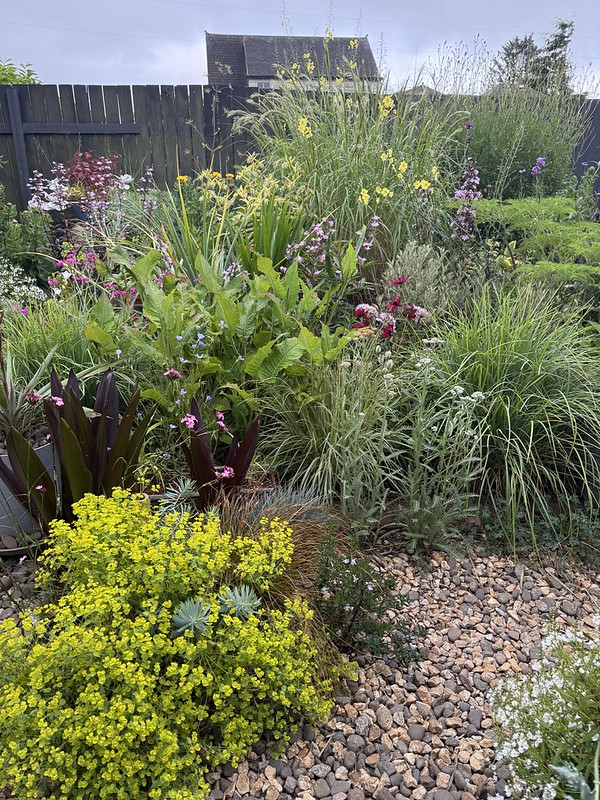
Here’s the view of the Oregon Coast back garden through the sliding doors, a view I look at a lot. Like both my gardens, it’s small and densely planted. It’s still exciting to throw back the curtains every morning and head outside, just as it was opening the kitchen door onto the LA/Long Beach, CA garden all those years. Everything in Oregon has to survive the winter while I’m gone, without protection, just as the zone 10 garden has to survive the summer while I’m here, with minimal supplemental irrigation. (Marty is in Long Beach right now and watering liberally; the garden is definitely showing the stress. I think the neighbors who promised to water occasionally went camping.)
looking east down the length of the small patio. I can’t wait to see what a young Euphorbia ceratocarpa and Grevillea ‘The Precious’ planted along that fence look like next year.
taken about a week ago, before I moved the potted single orange dahlia closer to the hose. Keeping the container watered in August became a daily job. The dahlia definitely needs to be removed from its galvanized tub and split up next spring. When I split Sanguisorba ‘Red Thunder’ then too I may try some of this dahlia in the back border.
I think this is pretty much peak summer 2026, with nothing else waiting in the wings to make an appearance. All the early performers are submerged under the growth of mid to late summer.
Dahlia ‘Windcliff Peach’ and a very dozy bee
the dahlia tank was sitting in front of Persicaria ‘Blackfield.’ Both the sesleria and persicaria are forgiving plants that accommodate squeezing in any summer containers. I’ve plunged in pots of cosmos here too. Yellow sprays of Verbascum roripifolium have continued all summer. It tends to grow horizontal, so cutting back the top growth makes more side shoots that create the cloud effect.
I’m always mentally toggling back and forth between the two gardens, so some quick context might be helpful. This is my sixth summer here playing in a new garden on the Oregon Coast zone 8-9, after 30-some years in LA’s zone 10 frostless garden. But old habits die hard — I still mostly plant for a dry summer. It’s the cool summers on the coast that make all the difference as far as quality and length of bloom. Even easy stuff like cosmos was a struggle in zone 10 summers.
leaving the back porch and into the garden looking east. Tithonia towers over the lobelia now but still no blooms — maybe September. The cool climate has its strengths as well as drawbacks
On the coast I stick to small simple flowers that make a wash of color and avoid more resource-intensive things like roses, peonies, clematis and others whose growth habits and down time I find difficult to handle in a small garden. If there’s one constant between the two gardens, I’ve always been a “community organizer” type of gardener, preferring the overall effect to showcasing a certain plant, even making agaves and aloes share the spotlight with grasses and shrubs down south.
at the foot of the lobelia some oregano is coming into bloom with nearby rock gardenish tanks and Mangave ‘Whale Tale’
This little erodium has been in bloom since June, ‘Fran’s Delight’ from Xera Plantsin June before the reds of persicaria, sanguisorba and Lobelia tupa dominated
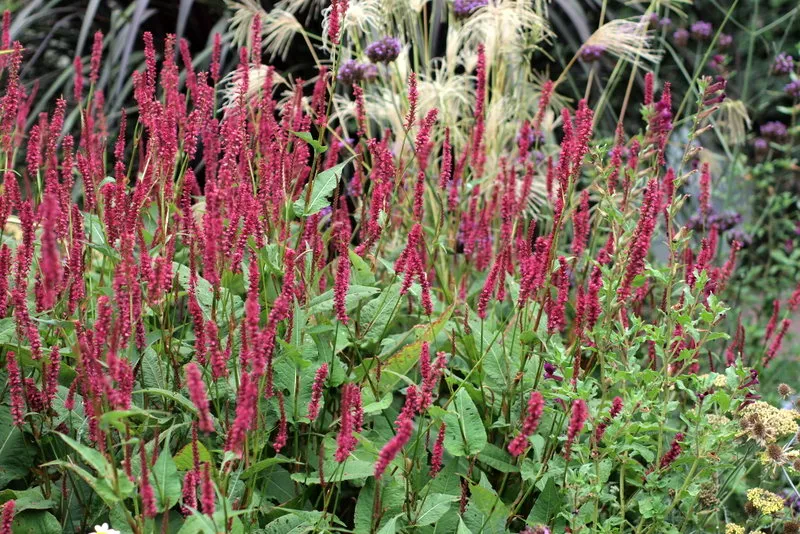
today, with a single eucomis bloom backed by persicaria
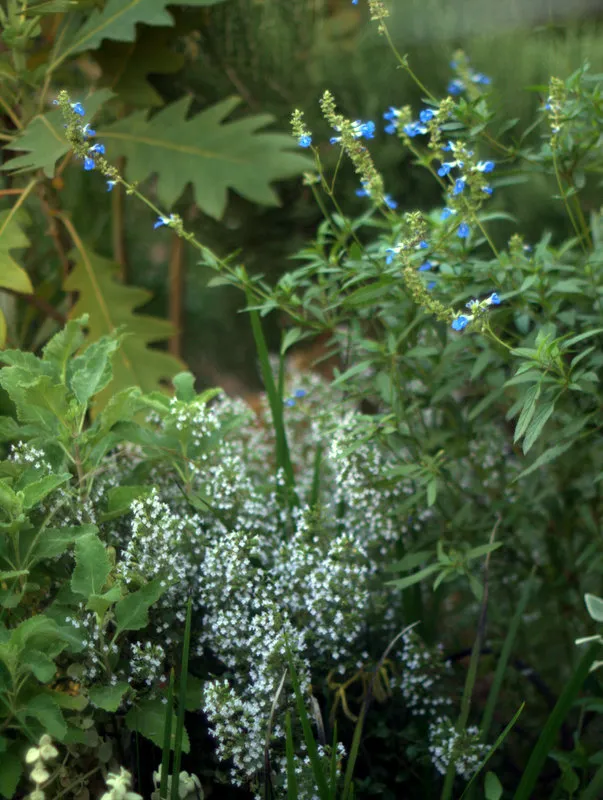
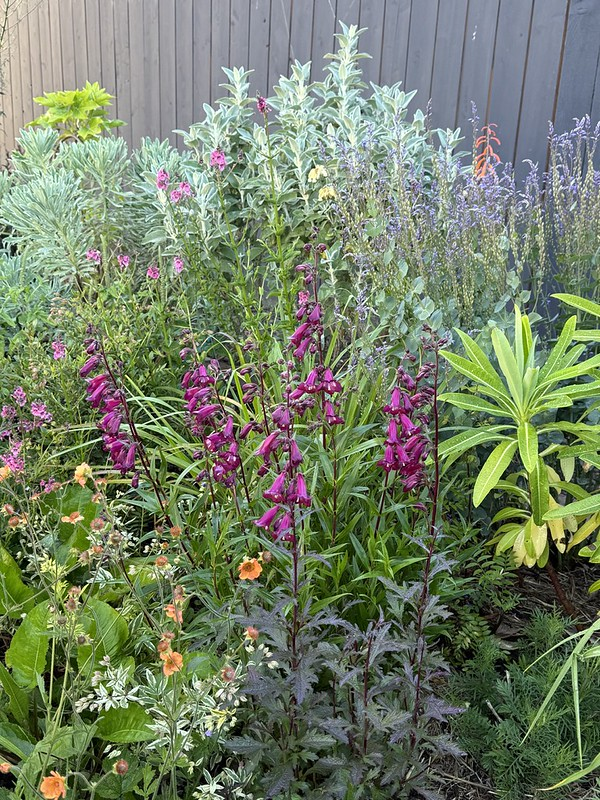
Calamint in bloom, the sterile ‘Montrose White.’ Another plant that grows well in both north and south gardens, extremely dry tolerant. Releases wonderful minty scent when brushed which makes it great for narrow pathszone 10 garden September 2016. Both Salvia uliginosa and calamint are included in the Oregon coast garden this year as well Mid-June with penstemons and geum, showing an example of the successions rolling through the garden.
mid August with persicaria and Scabiosa ochroleuca dominant. Funnily enough, both of these plants are the rare perennials that performed in summer in the zone 10 garden too. The scabiosa is famously dry tolerant (and a vigorous reseeder). The persicaria is usually recommended for moist conditions but if your soil is heavy, like mine in LA and Oregon, it handles dryish conditions well and doesn’t seem to require a winter rest to bloom.persicaria in the zone 10 garden August 2013. In winter in zone 10 I always begrudge the space given to summer-performing plants and usually reclaim it for another aloe or agave. Now that I’m in Oregon for summer, the Long Beach garden no longer has to entertain me both winter and summer
in the narrow beds on the east side, the “community organizing” style and succession planting that I find a lot of fun is less effective, a good place for standouts like Rubus lineatus
Joe-pye weed was removed from the back garden and added to the narrow borders on the east side
so cool — low tide at Cape Meares yesterday morning
This was a great post for really appreciating what it is you do, and how your “community organizing” style creates such a layered interesting garden, wait, make that gardens. It also furthered my hypothesis that if you gave three gardeners the same plot of land and 25 plants to play with they would all create very different gardens. We’re so lucky you’re still blogging and sharing!
@Kris, thanks for the encouragement. And I have plenty of envy for your extensive garden!
@DG, funny you should mention blogging. I have had one problem after another lately which makes Insta look more and more the way to go, maybe 2027 will see some changes. I know Blogger has issues too, but I don’t have the tech savvy to keep up with WordPress. Not sure if AI is precipitating all these issues in the last. year or so, who knows? So true about the 25 plants theory. Thanks for the kind words!
Wow, your garden is feeling an August groove! It really is the best of both worlds switching things up, is the time evenly divided? Or are you in Long Beach for a bigger part of the year? That walkway looks fabulous, what an excellent backdrop.
@Chavli, the boardwalk makes that east side a destination now — I love it!
@Tracy, the time is roughly evenly split up, summers in Oregon, winters in CA.







You’ve done a great job juggling the two gardens, Denise. It’s got to be fun to compare and contrast them. I envy your opportunity to do that!
This was a great post for really appreciating what it is you do, and how your “community organizing” style creates such a layered interesting garden, wait, make that gardens. It also furthered my hypothesis that if you gave three gardeners the same plot of land and 25 plants to play with they would all create very different gardens. We’re so lucky you’re still blogging and sharing!
@Kris, thanks for the encouragement. And I have plenty of envy for your extensive garden!
@DG, funny you should mention blogging. I have had one problem after another lately which makes Insta look more and more the way to go, maybe 2027 will see some changes. I know Blogger has issues too, but I don’t have the tech savvy to keep up with WordPress. Not sure if AI is precipitating all these issues in the last. year or so, who knows? So true about the 25 plants theory. Thanks for the kind words!
I love your boardwalk! I know it is still quite new. How are you enjoying it?
Wow, your garden is feeling an August groove! It really is the best of both worlds switching things up, is the time evenly divided? Or are you in Long Beach for a bigger part of the year? That walkway looks fabulous, what an excellent backdrop.
@Chavli, the boardwalk makes that east side a destination now — I love it!
@Tracy, the time is roughly evenly split up, summers in Oregon, winters in CA.