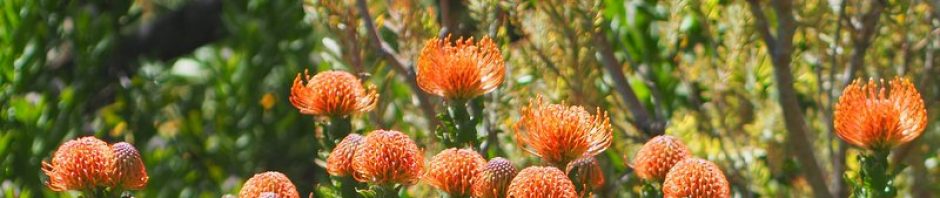
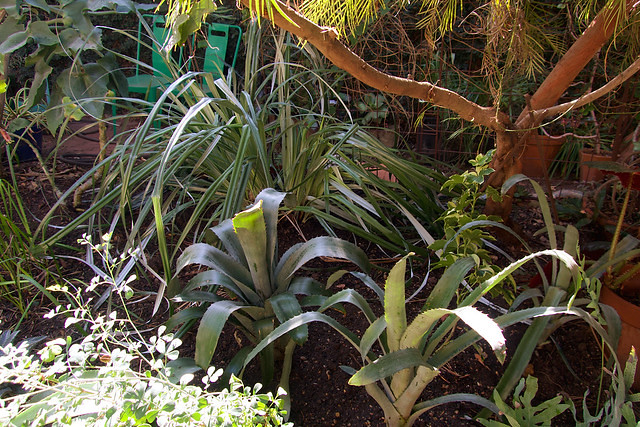
Returning from a 10-day trip over Thanksgiving, the garden buzzed with energy from emerging aloe flowers.
Aloe ‘Moonglow’
Seeing the refreshed garden after the weeks of cleanup in October/November was a pretty special homecoming.
Aloe ‘David Verity’ (I think)
Catching the aloes starting their winter bloom cycle is an event I’ve missed in our 3-year absence. It’s reassuring to find that, whatever conditions the aloes endured, they’ve not missed a beat.
Felicia echinata, the dune daisy, from Curious Flora — new perennial acquisitions are getting trialed in containers
Another classic road trip benefit is…bringing home plants. I’ve been reluctant to add much to a garden that has to survive without a caretaker half the year until I find an arrangement that works. So adding in perennials among succulents has been crossed off garden practices for now — other than the existing reseeders like Sonchus palmensis and Geranium palmatum. But our route home took us 5 minutes away from Curious Flora (formerly Annies Annuals). Marty insisted!
Trichostema ‘Midnight Magic,’ a hybrid of the native Woolly Blue Curls from Curious Flora
Here’s the basic outline of the road trip. Thanksgiving dinner had us in Sebastopol, north of San Francisco, and we decided to add on a quick trip back to the Oregon Coast since we were sort of halfway there already. The only consideration was the state of the road up Interstate 5 at Mount Shasta. Tire chains necessary? Icy conditions? Using Highway 101 as an alternative adds about two hours travel time, but we opted for the optimal road conditions it offers in December. The stunning scenery 101 provides was a benefit we’d forgotten. It had been years since we’d driven up Highway 101, encountering herds of elk while driving through redwoods in Northern California, the spectacular Oregon coast at Bandon, Florence, Yachats — it was an ecstatic drive. We somehow managed to avoid a drop of rain the entire time. I was looking forward to some rain in Tillamook, but it too was dry and frosty, and I stayed housebound with a head cold for nearly the entire visit.
Even though technically hardy in Tillamook’s zone 8, I brought Agave toumeyana back to the zone 10 garden to fatten it up with some winter sunshine.
On the return drive south, to cross over from 101 back to Interstate 5 near San Francisco took us right past Curious Flora, formerly Annies Annuals, now reincarnated as a retail nursery, no longer offering mail order. Arriving near closing, there was no time for photos but just enough time to bask in the enduring glow of this incredible nursery. The huge Agave ovatifolia is still there anchoring its nursery bed. The cow had been returned to its rightful place near the entrance. And table after table brimmed with transcendently healthy and alluring nursery stock, with names very familiar to us catalogue junkies (on labels that already reflected the owner change to Curious Flora.) It was a very reassuring visit, with cheerful employees bustling about, all the plants still safely under the care of long-time knowledgeable staff. (Another recent source of plants came from an excellent local nursery now calling it quits, with no happy ending on the horizon. A 3-gallon Beschorneria ‘Flamingo Glow’ and gallons each of Aloe brevifolia and Aloe ‘Always Red,’ all planted yesterday, all three plants for a total of $20 at 75% discount.)
Weeks-old Dioscorea elephantipes
A little pot of recently germinated Dioscorea elephantipes accompanied us on our travels, too fragile to be left behind. From 5-year-old seed from the Denver Botanic Garden, I was astonished to find two seedlings not long after sowing in October. A third seedling germinated in late November, after I inadvertently left the pot out over a cold night in Sebastopol. I wasn’t much of a fan of caudiciforms previously, so let the seeds idle for years. I always thought they were the least attractive plants at succulent shows! Now I appreciate their waterwise longevity, both as plants and seeds! If they survive, these plants will outlast me.
(A quick recap. Creeping fig, Ficus pumila, covered the south CMU wall of the back garden since we bought in ’89. Clinging tightly, it grew tall and thick and provided excellent evergreen privacy. A couple years ago, the neighbor on the other side of the CMU wall tired of the upkeep and tore it off his side. From that point the weight imbalance proved fatal, and during heavy wind last year it cleaved off our side of the wall too. Overnight the 9-foot green wall turned into a 6-foot pink wall that no longer provided privacy. Tenants said nothing of the collapse, and I only discovered it on a quick visit, lying like a rug over the back garden. (I’m pretty sure that’s what killed the bocconia and more.) I also hated the constant upkeep, but I loved watching possums stealthily navigate the green wall, creating mysterious waves of crunchy leafy movement, only a slim tail in evidence. It was wonderful for wildlife; birds, possums, raccoons, fig wasps.)
Various euphorbias like the corncob euphorb (E. mammilaris) and a trailing caput-medusae were rewarded for surviving in individual small pots with a slightly larger group pot slipped into the urn
Early morning photos are a little dark, but the colors are basically true. CMU cinderblock soaks up a lot of paint, three undercoats and a final color coat. Four colors, mustard, grey-blue, pale yellow/chartreuse and pea green. Mustard and grey-blue are repeated, six panels in all. The visible wood supports were painted pea green. Except for the mustard, the choice of colors was mostly inspired by the succulents themselves.
a wood turner was getting rid of lots of spindles a few years back and it was time to use them or toss them, and now seemed a good time with the garden relatively bare. Experimenting with placement before paint, ideally groups of three totems in varying heights using leftover fence paint.
showing the southeast corner where the varying fence heights meet — no need to extend height on the east side and usually this corner is covered by the neighbor’s wisteria and pepper tree all recently pruned. When covered with creeping fig, an additional 2-3 feet of depth was added to the boundary wall, maybe more if not kept tightly trimmed. And the branches eventually thickened to the point that a tight trim was impossible.
the green is a little blotchy and needs another pass with the roller
waking up to the garden the morning after the panels were up brought some calm I didn’t know I was missing
A vendor at the Long Beach flea had some nice plants including some amazing greenovias from South Korea. Cash only, so I had to pass. But I did shake out all our pockets for this Aeonium ‘Pink Witch.’
And some plant news. For locals, the Long Beach Armstrong’s currently has in stock the hard-to-find natural hybrid Alyogyne ‘Ruth Bancroft.’ I’ve sworn to do very little new planting but did manage to shoehorn in this one.
Now that the back garden has been (mostly) cleared and sorted, it’s a little weird to find that some of the remaining plants have now turned into nameless strangers. Especially the aloes. The one pictured, with the elegant scroll-worked leaves, I’ve finally decided must be Aloe pluridens aka the French Aloe. I’ve been making progress with identification through checking old photos and blog posts, a comforting post-election distraction. There’s just one other aloe that will remain a mystery to be solved once it flowers.
Aloe pluridens?
I wish I could just as easily untangle the painful mystery of the recent election results. There are lots of theories on offer. Democrats have lost the working class voter because __________. The degraded state of the information ecosystem is certainly a factor, and I have a little story that might illustrate this part of the puzzle.
On the North Oregon Coast, where we’ve spent the better part of the last three years near Tillamook Bay, work is now underway on repairing the South Jetty. What may sound like a straightforward construction project is anything but to the locals. It concerns infamously hazardous conditions arising from the convergence of fresh water from five rivers exiting through the narrow mouth of the bay. The crabbing and abundance of steelhead and salmon make this coast prime fishing, but the turbulent waters have taken their toll on the community in lives and income lost. Some families lost a husband and a son in a single disastrous fishing trip.
Kincheloe Point was named for the surveyor Julius Kincheloe who drowned in 1867 while sounding the bar. The lost city of Bayocean was settled on this peninsula in 1909.
Proposals for solutions go back to early in the last century, when an oceanfront community raised the funds for the Army Corps of Engineers to tame the waters and make the boat journey to their homes a little less harrowing. Two jetties were recommended, one on each side of the bay’s mouth, but funds enough for only one jetty were raised. The one-sided solution only exacerbated the problem, and the community named Bayocean was ultimately swept away by the sea.
By the 21st century, both north and south jetties were in place, with continual repairs needed to strengthen them. In particular, local government has sought repairs to the South Jetty since 2009. In January 2022, $62 million was allocated from the Infrastructure Investment and Jobs Act for repair of the South Jetty. The source of funding is not a secret but it doesn’t appear to be widely known and/or acknowledged either. This work critical to the small fishing communities will undoubtedly be completed under the incoming president’s term, the one voted in office by Tillamook County. The one who never got an “Infrastructure Week” off the ground. The one who didn’t fund the jetty work when he had a chance. The one who will probably take credit for the economic success all these projects will deliver.
There are thousands of such projects underway right now in every state. (You can check the work funded in your state here.) For me this is the kind of problem-solving that one party consistently delivers for voters. Sure, there’s a long arc and it can take years to see results. Would hearing some of these infrastructure success stories on the campaign trail have made a difference? What do I know, I’m just an old liberal…
Marty is quickly finishing work on the fence project. Fence is fresh painted a light grey, multi-color panels yet to be decided. The neighbor’s roofline is all that’s visible, a vast improvement over looking in their windows.
new planting under Grevillea ‘Moonlight’ November 2020, foreground bromeliad is Bilbergia ‘Violetta,’ original plant purchased in 2013
In November 2020 I moved a couple pups of Bilbergia ‘Violetta’ under Grevillea ‘Moonlight,’ along with a large astelia and other odds and ends. Only the bromeliads and Callisia fragrans survived. (The callisia aka Basket Plant or False Bromeliad, also multiplied like crazy.) Because I knew this would be a nasty, scratchy job, this was the last area to be cleaned up a couple days ago.
bromeliads and Callisia fragrans prior to cleanup
Those two ‘Violetta’ pups expanded into three large clumps, 3′ in height, with numerous offsets, all moved to the east side of the garden.
Bilbergia ‘Violetta’ moved against east fence October 25, 2024. Silvery Gomphostigma virgatum is new.
Cleaning up the broms filled with grevillea leaves and seedpods took hours. Other than cleaning, the clumps were left intact. Their new location on the east side of the garden will no doubt result in debris raining down on the broms as well, but hopefully a lesser amount. Judging by the vigor and health of ‘Violetta,’ in habitat broms must be pigs for debris-filled conditions.
grey metal fence meets pink CMU wall getting prepped for paint
Two more large clumps of ‘Violetta’ were moved in front of the African Spear Lily (Doryanthes palmeri) and Giant Crinum (C. asiaticum), and the step-down in scale they provide looks right to me. Lots of Callisia fragrans were moved here as well. The plan is to rework the garden with the plants with the proven toughest bonafides. Geranium palmatum and Sonchus palmensis are seeding into the rock spine, which is fine by my new laissez-faire attitude. Covering the ground and keeping out weeds are paramount.
rock spine planted November 2020. Most of the small planting done then is gone.
Initially I planned to paint the CMU wall one color, specifically a pea-green color similar to the panel in the above photo. Marty leans toward painting the entire wall grey to tie into the metal fence on the east side. But then I found the above photo of work done by Terremoto with panels of color, and I think this is my preference. One of the panels would be grey to link to the metal fence. Too institutional for a home garden? Opinions welcome!
CMU wall runs southern length of the garden. Patch of St. Augustine’s grass is just past the grate on the left
The middle of the garden has been emptied out of weeds, dead or dying plants. A lanky Strobilanthes gossypinus was beat up but still alive, so it’s been pruned and retained. The ‘Golfball’ pittosporum on the right was also retained and will be cut back fairly hard. The clump of Eryngium pandanifolium seen against the CMU wall was thinned to two rosettes. Amazing how this eryngo tolerates the wet of the Oregon garden as well as the dryness in Los Angeles.
Drawback of furry-leaved plants lijke Strobilanthes gossypinus is the grime they accumulate. This is an improvement after repeated mistings.
Agave ‘Ray of Light’ is luminous again after hand-washing the leaves
Variegated St. Augustine’s grass spread into a large bright patch, clambering over possibly agapanthus, giant fennel, and who knows what else. It’s earned a place in this part-time garden. Flicker of magenta on the left comes from Salvia chiapensis, found locally, something for the hummingbirds in addition to the grevillea and pedilanthus/Tall Slipper Plant.
so impressed with Carex ‘Feather Falls’
Like the St. Augustine’s grass, Carex ‘Feather Falls’ didn’t even require any cleaning. Yucca rostrata finally developed a bit of a trunk in my absence, which still needs some cleanup. Let me know your thoughts on painting the CMU one color or multiple panels of color. Input, please!
I confess the loss of Beaucarnea ‘Gold Star’ was one I dreaded the most during our extended absence. It was one of the first plants I rushed to check upon return. Survival of caudiciform plants was a theme.
xCalibanus hookeri
Right up there with worrying over Beaucarnia ‘Gold Star’ was concern for its relative xCalibanus hookeri, or Calicarnea, a cross between beaucarnia and calibanus found at Lotusland. It was a mass of undifferentiated writhing leaves until I excitedly stripped away the lower growth to reveal the beautiful shape of its swollen, water-storing trunk for the first time. Caudiciform plants share this trick of being able to store water in their swollen stems, trunks, and above-ground roots. Inadvertently, I’d accumulated a small collection of them: beaucarnias, cussonias, brachychiton, and pseudobombax, and every one of them managed to survive. All but Cussonia paniculata and the calicarnea were in containers.
newly potted Cussonia paniculata
Admittedly, the two cabbage trees are a little thin on top. Cussonia paniculata was planted in the ground to improve its survival odds, and it was developing a nice mop of leaves until someone felt moved to chop them off. At that point, on a quick return visit, I assumed the plant was done. Seeing this new crop of leaves spurred me to move it back to a pot again in the hopes that a container implies the plant is special, that it enjoys protected status and is not to be messed with.
Cussonia paniculata
Cussonia spicata in the tall grey pot, long trunk
Cussonia spicata has always suffered from a receding hairline, so its thin canopy wasn’t much of a change. It’s been moved to a site with more sun, at the end of the pergola where the tetrapanax once held court and the Passiflora vitifolia was removed. (Tetrapanax may be in just temporary exile, lurking and waiting for more irrigation. I like him better in the coastal Oregon garden, so wouldn’t mind if he calls it quits here.). As usual I’m terrible with before-and-after documentation, but did take a short video, link here.
Not only did the potted brachychiton survive the neglect, but Farfugium japonicum ‘Shishi Botan’ did as well, so it was brought along and rehomed in the tank too. A couple of ankle-biting dyckias were planted at the edge of the tank to drape over the side.
The trunk behind the silver dickia belongs to Brachychiton discolor. Its trunk swells but not to the pronounced effect of Brachychiton rupestris aka the Bottle Tree. My 8-foot Queensland Lacebark survived in a 14-inch pot so earned an upgrade to this heavy tank. (The tank years ago housed Agave vilmoriniana ‘Stained Glass’ but was no longer in use, I moved it to this site vacated by Grevillea ‘Poorinda Blondie’ that died while I was away.).
pulling down a maple-like leaf of Brachychiton discolor for a better view. The accumulation of filth on the leaves is typical of the dry garden here.
Silvery Hechtia tillandsioides with Orthophytum magalhaesii on the right handling life without me very well
on the right, Agave ‘Mateo’ was newly moved to the back garden. The front garden is where the plants sustained the most careless treatment e.g., the cussonia getting topped, the Nolina nelsonii getting porcupined. ‘Mateo’ is getting big enough that I feared he would be getting similar treatment if not moved.
Agave ‘Mateo’ with Yucca ‘Magenta Magic’ on the right, which tolerated the dry conditions effortlessly
leaning trunk of Pseudobombax ellipticum
Pseudobombax ellipticum, the Shaving Brush Tree, is also comically tall and skinny but has earned some extra TLC. The fernleaf acacia is sporting its new limbed-up profile. A helpful neighbor was let loose with a saw and pruners. It’s a messy tree and needed handling, but it’s still a shock to see the canopy reduced to such an extent. I’ve yet to clean out the Yucca rostrata, clotted with years of debris from the acacia. Essential for shade and wildlife, nevertheless trees are the bane of a succulent garden!
after cleaning and repotting
87F yesterday, still in the mid 80s today, maybe some clouds by the end of the week to turn off this microwave oven of dry heat. Possibility of a frost tonight on the north Oregon coast. Take care!
I know “runaway garden” is an oxymoron, but even so the SoCal garden (zone 10) seems to have been on a journey without me, cycling through various caretakers, some benign, some less so. The last few days have been the longest time I’ve spent in it since that leavetaking in October 2021. Since returning it’s been nonstop cleanup and sorting out disputes among some very large succulents, retaining the best and generally thinning out the garden for easier future maintenance. And making it safer for kids and future guests.
But I am so impressed with the resilience of the succulents.
Aloe tongaensis ‘Medusa’ is one of many succulents that flourished in pots in my absence. A potted tree Aloe ‘Goliath’ toppled and could not be saved, so ‘Medusa’ is some consolation.
Pots and garden were all bone dry on my return. (The last guest left six weeks ago, and the garden probably had better survival odds once they departed.) In the above photo, the potted ‘Medusa’ and Euphorbia canariensis were both moved to this corner, which is in the process of being reworked almost entirely, a mix of in-ground plants and potted. (If a plant survived all this time in a pot, it stays potted, especially the larger specimens). A poorly placed Aloe marlothii was removed, as was Agave lophantha ‘Quadricolor’ — its leaves were cut off by caretakers, so the plant was basically ruined. Same for an enormous Agave kerchovei ‘Huajapan Red’ that never reddened but was nevertheless stunning if growing too large for its spot. The potted cordyline surprisingly survived the crush of plants and lack of water.
On the right, Aloe capitata x quartziticola was salvaged, overgrown by a leaning Leucadendron ‘Jester’ that had to come out. Small rosette-type aloes will be planted near the paths, with spikier stuff like the Euphorbia canariensis moved further back.
While I was away, the weeds flourished (crouch grass, oxalis, bronze fennel, even Solanum pyracanthos and a prolific euphorbia that I no doubt introduced). The unclipped creeping fig vine had sheared off the back wall from its excessive height and weight, leaving the flesh-colored CMU and the once-hidden neighboring houses visible, which takes getting used to. The passion vine, Passiflora vitifolia, clambered everywhere, hanging in curtains from the pergola, scaling the acacia tree, the roof. Removing the passion vine was key in assessing what could be saved.
Agave celsii var. albicans needs a cleaning but is otherwise in good shape. I’d like to pry that offset away from the mother plant eventually
Weeds covered the ground and encompassed those astonishing survivors, the succulents. (Long sleeves, gloves, and a hemostat are essential.) As much as I fought having a wholly succulent garden, loving the sculptural beauty but less so the inert, seasonless effect, I now recognize that if a frost-free garden is going to be abandoned for years at a time, succulents are the answer. A tree-like Grevillea ‘Moonlight’ and huge clump of Pedilanthus bracteatus continue to satisfy the bees and hummingbirds, animating the garden with a whirring, buzzing soundtrack.
I really did not expect so many small potted succulents to survive, like this Aloe erinacea — I’m impressed!
One of two large tractor funnels packed with every manner of hanging succulent, very dry but still happy. Red rosette on the left is Callisia fragrans, stressed but alive. Tillandsias did surprisingly well too. Very overcast today so photo had to be brightened quite a bit.
There were just a few non-succulent plants that flourished in the neglect, like sonchus, looking amazingly fresh. The tetrapanax and a large Grevillea ‘Poorinda Blondie’ both perished.
The mangaves surprisingly managed fine in the dry conditions too.
Alcantarea imperialis with pyrrosia, a pot I protected against the east side of the house — thrilled that they survived.
The bromeliads did very well too, apart from being covered in debris, which choked all the plants, succulents and bromeliads.
Agave ‘Snow Glow’ managed to maintain flawless good looks. The garden is desperately in need of mulch for new paths and the changed layout — I’ll be checking out a supposedly free municipal supply.
Billie has found her spot on the hand-me-down couch in the sun room with a view of the street. The shaved area from the ACL repair is growing in and she finished her meds yesterday. (Surgery was Sept. 11.) She was under a year old when she last lived in this house.
spiders have owned the garden since mid-September which means I stick to the perimeter path. Doing some quick research, I found that the spiders of autumn arrive huge seemingly overnight because they have been unobtrusively eating insects all summer and growing in size. Their plans for fall are to mate, lay eggs and die. And I respect that.
Even though I’m the main instigator, this late-season crescendo of growth astonishes me.
The garden has adopted a late-season agenda of its own. Aster horizontalis just might be the last to bloom, a boon to all the pollinators hanging around and looking for what’s next on the menu
the late-flowering unknown species salvia from Szechuan via nursery Flowers by the Sea, now closed.
While the garden has morphed into a late-season mosh pit, there has been one summer-long standout that still rises above and coolly surveys the garden’s autumnal slugfest: Verbascum roripifolium, sown spring 2023. A verbascum that flowers in a towering cloud, not a spire, and has been described by plant nurseries variously as an annual, biennial. Three of the five sown spring 2023 bloomed gloriously summer 2023, never to return. Two plants out of five sown in spring 2023 did not bloom the first year, kept basal growth in winter, and have been in bloom all spring/summer/fall 2024, which makes them…what? A little long in the tooth for a biennial. Short-lived perennial? It must be this confusion as to its lifespan and handling that costs this wonderful plant more popularity. And because it’s as kinetic as a Calder mobile, photography is worthless for advertising its charms.
Verbascum roripifolium snagged by Eryngium pandanifolium
Verbascum roripifolium — If only it reseeded like other mulleins!
other standouts include the 8-foot beanstalk quality growth on Persicaria orientalis
notes for next year: stake the dahlias!
Twynings After Eight is a keeper, medium stature, clean leaves, moody charms
the bog sage gains depth of color as the days and nights get cooler
like a late-night party spun out of control, I confess I am looking forward to this mass of growth getting knocked back by winter and watching it all start up again next spring. I did remove that phormium a couple days ago, replacing it with smaller Astelia chathamica
Unlike last year, when I selectively cut back stuff as it got battered by winter storms, I’ll be closing the door on this garden as it exists now, leaving it to wildlife and the elements, until I see it again in spring. Next post will be coming from Long Beach, where a mess awaits me there as surely as one will await me in Oregon in spring — thank goodness small gardens make small messes! I’ve always been drawn to the Japanese fairy tale The Boy Who Drew Cats, with the life-saving instruction “Avoid large spaces, keep to the small,” and that admonition has served me on many levels. (Except in spider season, when wider pathways in the garden would be a welcome luxury.) The monster in the story is a giant rat that rules an abandoned temple where an outcast boy takes shelter one dark stormy night. Having been ostracized for preferring drawing to “serious” pursuits, the boy reflexively covers the temple walls with drawings of cats to soothe himself to sleep. When the fearsome and murderous rodent appears in the night to dispatch the sleeping boy…well, once again the power of art saves a child. Just as the power of gardens has saved me time and time again. Take care, AGO
early September with kniphofia leaves fountaining center left beyond railroad tie
I’m not referring to surprises in the sense of predicted late-season arrivals, but just the generic, built-in unpredictability of plants we choose for our gardens. A plant’s performance can be dramatically different just down the street, not to mention spanning seemingly appropriate climate zones.
first week of September, Kniphofia caulescens throws its first bloom. A couple more clumps would be ideal but the garden is booked unless something is forced to give up its spot
Take Kniphofia caulescens, for instance. This poker has been contributing its beautifully glaucous presence all year. The writhing, blue, cephalopod-like leaves are so good I almost forgot that it might want to contribute a flower as well. I realistically accepted around the time of planting that it might not be hot enough here to flower — wrong! Even pre-heat wave in early September (two days around 86F), we had bud launch!
that other writhing mass of strappy energy in the background is Eryngium pandandifolium
At home in higher elevations in South Africa, it’s hardy to at least zone 6, so definitely not a risky gambit here in zone 8b (sliding into zone 9), but there remained the question of whether it could flower in this cool growing season. Mine came from Secret Garden Growers, planted in October 2022.
The color is deceptively solid in the early stages, but it does age to bicolor. So good with sesleria in bloom too.
looking to the west, through the fizz of deschampsia, scabiosa, succisella, can you spot the resolute poker?
The strong outline is especially appreciated in September when so much of the garden is a buzzy fizz. Everything bobbing and weaving and looking for a shoulder to lean on — except for the resolute poker. All that fascinating buzzing activity brings out the only wildlife I dread and am always on high alert for in autumn — spiders! (Is there one in my hair? Check my back!) Knocking webs out of high traffic areas is once again the morning routine.
Amaranthus caudatus ‘Mira’
Unlike the kniphofia, whose flowering was exciting but not the main point, annuals like amaranthus were sown in April for their blooms. To give them the best shot, I potted the seedlings on in increasingly bigger pots, ending with one plant per 3-gallon pot. About five of these pots were plunged into various full-sun spots in the garden. They started flowering late August.
Blends in well with the buff grasses — or would dark Hopi’s Red Dye be a better choice? The New Zealand Purple castor bean to its left didn’t make much size at all over summer, started from seed in April. Better to bring in nursery-grown plants next year fatted up in greenhouses
The uncertainty over whether the amaranthus would bloom before first frost was nerve-wracking, but they somehow managed it. I imagine they’d be a lot taller with more blooms in a warmer summer than mine. But watching them gain height and then drip those ropes of chenille flowers strikes me as worth the effort — better yet, maybe they’ll self-sow.
canna ‘Cleopatra’ not only managed to push some leaves up through the jungle but also a bloom
The canna ‘Cleopatra’ had a couple surprises for September. First, that it managed to push leaves up through the dense planting on all sides counts as a triumph.
with Solidago ‘Fireworks’ just coloring up, left, and Lobelia tupa, extreme left
And then the tomato red flower took a bizarre turn when another flower opened canary yellow. I wasn’t really expecting the canna to bloom either and had forgotten it had this bicolor tic. Helping with the two-tone canna is the surprise echo of Solidago ‘Fireworks’ just starting to gleam near ruddy Lobelia tupa, yellow and red again, bringing some context to the bicolor craziness. But I was tempted to cut the flower stalk off entirely.
Some plants seem destined to have their flowers sacrificed to preserve their leafy good looks. Seems like everyone I know who grows Argentina lineata cuts off the small yellow flowers as insignificant distractions from the plush basal leaves, finely cut silver brocade.
Argentina (nee Potentilla) lineata in June. Celebrated as a foliage plant, with the small yellow flowers considered an annoyance by everyone I talk to who grows it.
Argentina lineata in September
But look at the scaffolding that hoists up those “insignificant” flowers! And insignificant is a subjective value judgment anyway — insects don’t seem to be hung up on size of flowers and throng to the small stuff.
Acacia cultriformis in the front garden was brought up three years ago from Los Angeles. All the knockbacks by winter have resulted in treating this acacia as a cutback shrub. It has already been surpassed in size by a year-old Acacia pravissima. The latter has the reputation for the hardiest acacia in zone 8-9ish. But how much of its growth will it hold on to after the next winter?
Acacia pravissima in back garden with Helianthus ‘Lemon Queen,’ both over 5 feet
Beschorrneria septentrionalis may not ever bloom here, but thank goodness it looks fabulous in leaf only. With the excellent Carex ‘Feather Falls’ in the background.
Making a garden has a lot to do with being able to predict how a plant will perform, and there are countless variables to consider, but still who doesn’t like to take a flier on mystery plants or plants we’ve only read about, or try a familiar plant in unfamiliar conditions? Since I plant so densely, my biggest problem is always with ultimate size, and I’m already running into crowding issues after just a few years.
Best bloom of two clumps of Calamagrostis brachytricha. This one was moved out of the large back border, where the other clump languishes, probably too crowded.
Cosmos ‘Rubenza’ — statuesque, long stems for cutting
The cosmos started in April added so much to the late garden. ‘Rubenza’ and ‘Apricotta’ were standouts. ‘Fandango’ and ‘Xsenia’ were good but more compact in size. (Thank you to Chilterns for sending ‘Fandango’ gratis!) If I follow the same sowing and planting times next year can I expect the same results? Possibly but no guaranties. Growing conditions are vacillating wildly year to year. I think starting seeds in late May rather than coolish April will bring as good as a result.
Cosmos ‘Rubenza’
Cosmos ‘Apricotta’ as good as ‘Rubenza’ if not superior in how long the flowers last on the plant
Senecia candicans ‘Angel Wings’
I’m seeing Senecio ‘Angel Wings’ in lots of gardens, but it seems to always be just the one clump, as though it’s grown as an annual and replanted in spring. My one clump was planted in this container and survived here last winter. That clump is now several clumps, following the contour of the container, rooting as it goes. Just an observation on what seems to make this inscrutable plant happy and expand in size year to year.
Repeat-blooming Anemone ‘Dainty Swan’ really took off this summer, blooming from June until the present. Metapanax delavayi on its right
Surprised this sideritis has survived a couple very wet winters.
Lastly, some notable events. Rain! A whole night and part of a day. Billie blew her ACL last weekend and is recovering from surgery. (We didn’t see the injury happen, but heard the commotion that had to do with a bench Billie uses to keep track of street activity via the large front window. From the barking, apparently a dog strolled by, Billie overreacted, twisted, fell and somehow blew the cruciate ligament.) We forced ourselves to sit through the debate, just as we did the last one, another stomach churner but for vastly different reasons!
anything better than autumn light?
Hope the weather is becoming more reasonably autumnal for you!
some phone photos from August 31, 2024. View of the Wonder Garden from the parking area adjacent to the library. Sailcloth is erected in summer over the main seating area. The HCA offices, galleries, and clay studio are housed across the street.
The Hoffman Center for the Arts in Manzanita, Oregon, celebrated its 20-year anniversary Saturday August 31. Out of their many programs — clay, writing, visual arts — I became acquainted with the HCA through their horticulture program. The Hoffman’s Wonder Garden for me was the design lab I needed to become acquainted with plants that grow well on the Oregon Coast. Indeed, this is the goal the WG’s volunteer director Ketzel Levine explicitly embraces as she showcases plants that endure both a very wet winter and very dry summer, USDA zone 9ish. A public garden with this kind of sophisticated planting is a rarity on the coast — actually, in my experience, it’s a rarity anywhere!
Library in the distance behind the life drawing pavilion which was set up on the parking lot for the celebration. Succulents were added to this berm for a summer display, which gives me a strong sense of SoCal deja vu! (Except for the hebes and scotch moss scattered throughout.) There have been offers of greenhouse space to protect the succulents in winter.
Evergreen ground cover in foreground is an excellent one for this coast — Baccharis magellanica ‘Inca Point’
Built on a gravel parking lot, the WG’s soil is excessively free draining; great for the rain-soaked winter, tricky in summer. During summer the WG needs thoughtful watering, especially since new plants are constantly being trialed and supplemental irrigation to the manzanitas is to be strictly avoided. The growing conditions are very different from my Tillamook soil which is rich and deep. (Just as an example of divergent plant choices, I’ve watched Lobelia tupa struggle at the WG but flourish in my own garden. Arctostaphylos ‘Ghostly’ survives in the WG but succumbed after last winter in my own garden. Euphorbia griffithii leaves burned in a heat wave at the WG but not in my garden, etc.)
note the towering snow gum eucalyptus at the far end of this bed, another testament to Manzanita’s propitious microclimate. Leucadendron galpinii and Acacia pravissima also thrive in this berm.
The berms are continually built back as they lose height and are kept carefully mulched. Instead of the usual fine bark mulch, this year yards of compost were spread in spring as a soil boost — but not to the manzanitas, of course! And I’m always surprised at what a heat trap this little garden becomes in high summer. Whether it’s a Manzanita microclimate or the heat absorbed and held by the gravel substrate and paths, shade cloths for the main seating areas are a necessity for visitors. However, on this mostly summer-cool coast, the plants flourish from the good summer baking the WG provides.
Over the few years I’ve been volunteering here, something else besides a personal horticultural education has crept into my relationship with the WG. And that is, the awareness of the immeasurable value even a small public garden brings to a community. To someone who previously equated gardens with sanctuary and privacy, witnessing a community bond with this little pass-through garden has been revelatory.
for Saturday’s celebration, a life drawing pavilion with easels was set up, with volunteers posing as models throughout the dayj. Just one of the many activities held on Saturday that also included opening and closing ceremonies, art stations, “plant bingo,” live music, and of course cake!
Unlike myself, many visitors are not always motivated to come to closely inspect plants and labels, but instead gather to meet up with friends for coffee or a picnic, knit under the shade awning, end a beach walk or shopping trip here, stop in after a library visit next-door, bring their dog to the always-full water bowl. Without fencing, and sited on a busy corner, it is a backdrop to daily rituals, an essential “third place” — somewhere to go outside of home and work. I overheard a woman exclaim about the WG on Saturday, “This is the best thing about living in Manzanita!”
Salvia reptans ‘West Texas Form,’ orange spire from Lobelia ‘Bruce Wakefield’ on left
So why doesn’t every town have a great third-space option like the Wonder Garden? A singularly fortuitous event set it all in motion. In 2004 an artist couple, the Hoffmans, gifted their home and land to found the HCA. So there’s that bit of foundational luck, followed by decades of strong community support. (If you think donating a small house and parcel of land to your town is not a worthwhile gesture, think again!)
Newly acquired from Ketzel’s buddies at Windcliff, no plant tag yet, possibly a leontodon?
Under the HCA umbrella, I think the Wonder Garden program at the Hoffman was started around 2014. Garden savvy journalist Ketzel Levine moved into town a few years later, volunteering decades of experience and contacts.
“Manzanita Moongate” screen by Indio Metal Arts installed this year — to make way for the screen, Marty grappled with removing the Mugo pine that did not want to leave! Lots of new planting in evidence, Acanthus sennii extreme right.
An enthusiastic base of volunteers is another incalculable asset to the HCA. As far as I can tell, the HCA has been run from inception by volunteers. It was just two years ago that the HCA acquired its first paid director.
And at the Wonder Garden, not every volunteer needs to bring a lifetime of plant knowledge, because there are so many other skills required to keep the garden flourishing. Plant sales run by volunteers provide funds for more plants and commissioned art work, like the new screen of salvage metal made by Indio Metal Arts.
Dahlia ‘Forncett’s Furnace’ with leptospermum, melianthus and lomatia
I have to emphasize that I am writing about the HCA as a non-resident newcomer, and I have to own any mistakes of omission as far as history and unfamiliarity with the many volunteers who have made this little slice of heaven possible. In my short experience there, the Wonder Garden proves that public gardens don’t necessarily need large tracts of land and paid staff, just a community that recognizes and rallies around their little oasis at the east end of town.
(photo from HCA’s Facebook)
There is an upcoming plant sale to be held on September 28, 10 a.m. to 12:30 p.m., including work for sale from Indio Metal Arts. Head’s up, sales are brisk, so try to be there as close to 10 a.m. as you can manage.
Dahlia ‘Windcliff Peach’ in a 17-gallon galvanized “bushel basket” under $30, a roomy container option
I love my new single dahlia so much I had to post another photo. Blazingly hot but fresh color is a nice look for an August that feels autumnal already. A cool August has brought the small herd of elk down from the mountains to the coast earlier than usual this year to their favorite winter grazing, a farm field off 101 about 5 miles north of me. I have a feeling the herd will magically disappear again by Thursday, headed for cooler mountain haunts, with temps predicted for 85F — not terrific heat but uncomfortable enough if you’re wearing a fur coat. The garden glistened from overnight rain this morning, but my potted dahlia will need vigilant watering in the coming heat later in the week to keep floating those saffron daisies through September. I love the sensation of the garden serving course after visual course through fall.
Just behind the phormium is where a lot of the late show is happening — selinum, joe-pye weed newly blooming against the established, long-blooming backdrop of Sanguisorba ‘Red Thunder,’ dahlias, patrinia, Persicaria polymorpha. I’m thinking about thinning the burgeoning phormium next year, depending on what this winter has in store. Maybe it will do some of the work for me. (Not in photo — Eryngium pandanifolium has three bloom stalks this year, taller than joe-pye weed so 7ish feet. And on the subject of eryngos, E. yuccifolium has just one bloom stalk, possibly diminishing from too much shade from the maturing tetrapanax. I’ll move just about any plant other than this touchy, tap-rooted eryngium. Better to start again from seed.)
The white and purple umbels of Selinum wallichianum and joe-pye weed are a great match for August
The joe-pye weed was lightly cut back around June so is possibly not as tall this year — 6 feet is a more than adequate height! Cirsium ‘Trevor’s Blue Wonder’ still throwing the occasional thistle bloom
another big presence, Lobelia tupa rubs shoulders with the joe-pye weed, about 14 stalks this year, screened in this view by Stipa gigangtea
Helianthus ‘Lemon Queen’ was moved into the southeast corner last year and was also lightly chopped back in June. (Unseen in photo, Salvia uliginosa nearby started blooming at the same time — always a surprise how late this salvia is here at the coast. But at least the bog sage ultimately delivers — Salvia patens is not worth growing here at all.)
In August Persicaria polymorpha’s white panicles begin to blush pink. This is not the invasive Japanese knotweed and doesn’t spread by underground runners — or seed, for that matter. Just a really good, easy shrub-like perennial all summer.
Lunaria annua ‘Chedglow’
This display of characterful leaves that’s extended all summer may be a one-off, so I’m hesitant to talk about them because I don’t fully understand what’s going on. They are carpeting the narrow border on the north side of the house. Lunaria is a biennial, so when these plants bloom next spring this show of leaves will be over. Somehow the timing of when I sowed and planted them resulted in big lush leaves all summer. It’s probably just a fluke that will be impossible to replicate. (The same lunaria in the back garden shows spindly leaf growth.) Lots of seed-grown aquilegia planted here are now buried under the lush growth of the lunaria (A. viridiflora, atrata, oxysepala) — oof! Like all lunaria, ‘Chedglow’ reseeds like crazy, so there will be plenty of opportunities to experiment again. Hopefully the baby columbine buried under those leaves have a survival plan they’re working on…