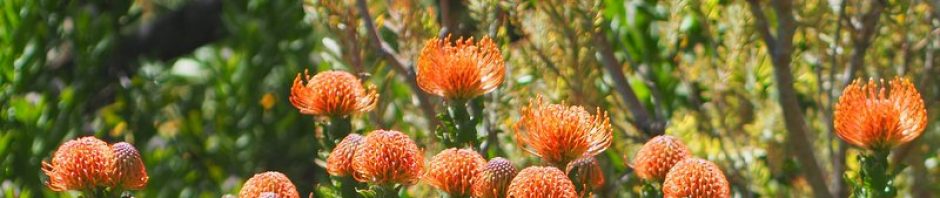
Ecological degradation starts innocently enough. On a walk into town, an unexpected jolt of clear orange spotted peripherally doubled me back to the rack of plants always on offer outside the local senior’s center. For sale for $6, and I only had a rumpled fiver in my pocket, but I couldn’t walk away. Promising to come back with the proper amount, after some back-and-forth it was mine for $5.50. (Mid negotiation I found 50 cents in another pocket.). No one knew the name. I told Marty I think it’s a hawkweed. Weird that I would intuit the correct common name. And another vague intuition told me to confine it to a pot.

As soon as it was potted I did an image search: Pilosella aurantiaca (formerly hieracium), the Orange Hawkweed. From the Alps, it’s been in Oregon maybe since the 1920s.
For a brief moment I was hopeful it needn’t be bagged and tossed in the trash. With climate change stressing and pushing fauna and flora off their local patch, there’s been some nuance injected into the discussion of native vs. exotic, with the acknowledgement that some exotics may be useful where natives can no longer cope. And, encouragingly, Beth Chatto Gardens describes it as: “A jolly little plant that adds a dot of orange over a long period from mid-summer to autumn. Long bristly black stems bearing clusters of burnt orange flowers arise from hairy rosettes of basal leaves. Attractive to many pollinators and with a preference for poorer soils, this is one for dry, arid conditions, banks or wildlife gardens. Dainty seeds are dispersed by the wind.”
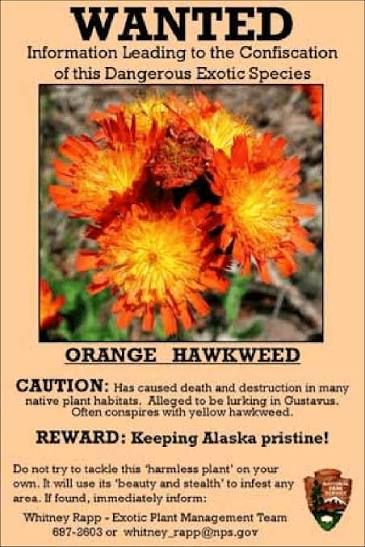
But giving the Orange Hawkweed the benefit of the doubt, with my enclosed garden within blocks of agricultural land, sounds like trouble for Oregon. It spreads by wind-driven seeds, stolons, and shallow rhizomes, a triple threat. And as if that wasn’t enough guarantee of survival, in its pursuit of monoculture, it possesses allelopathic abilities enabling it to suppress germination of surrounding flora. So add chemical warfare to its survival toolkit. It’s already a serious problem in Alaska. Also known as the Devil’s Paintbrush, an apt common name.
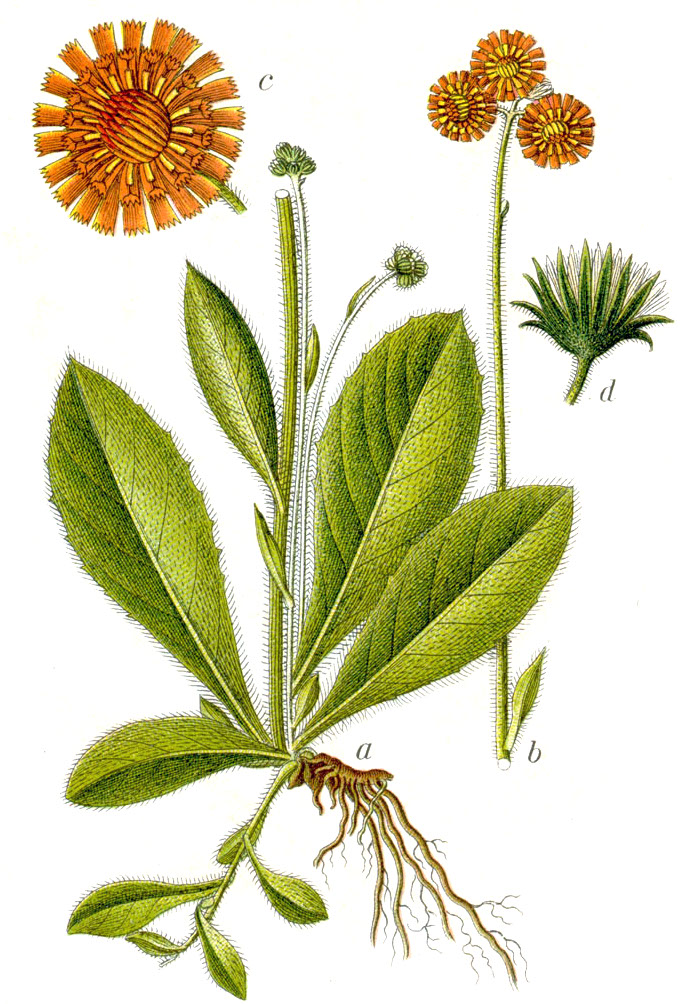
So seductively beautiful, so relentlessly aggressive. As a fan of all things orange, I was nearly recruited as one of its minions in aiding its pursuit of world domination, especially in cool wet climates. Marty jokingly said I should “drop a dime” on the sweet lady who sold it to me, aka report her to the invasive plant authorities. I’ll go back with an additional 50 cents and direct her to some info from the Clackamas Soil and Water Conservation District.

Ha! It IS pretty, though. I think you did the right thing.
These beauties can be so seductive! I have been similarly seduced by Verbena bonariensis, which I planted with delight, but is now on the Monitor List of the WA state Noxious Weed Control Board.
I first saw this lovely orange bloom during a visit to south coast of England and thought ‘Oh, how cool, they have orange dandelions’. Turns out they are from the same Asteraceae family.
I do hope the good people from the senior center will listen to you.
So many pretty plants are thugs in disguise. Creeping Bellflower (Campanula rapunculoides) comes to mind specifically here. The uninitiated love it’s tall lavender wands of bell shaped flowers completely unaware that it’s almost impossible to eradicate. Education is the best bet but we are losing the battle. This year the campanula was taken off of our noxious invasive plant’s list as it is considered too far gone to control.
Dang, I would’ve fallen for it in a split second! And you emptying your pockets for it, lol.
I was seduced by the Beth Chatto description, until the last line “Dainty seeds are dispersed by the wind”… Oregon thanks you.