Pennisetum villosum middle foreeground mid July 2025
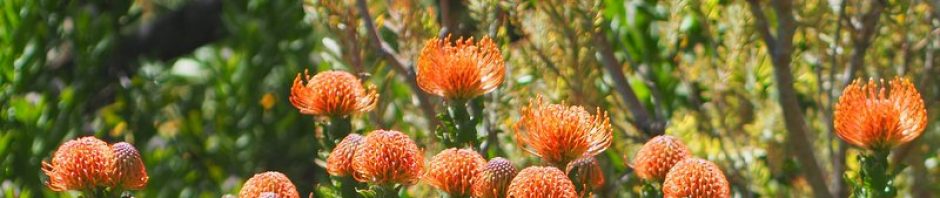
Feathertop Grass, known as the least robust of the fountain grasses, is everything I want in a medium-sized fluffy grass. Admired daily, I watched how the circumference of the clump expanded and stretched into the gravel and grew more and more exceptional in every way I wanted.
I never heard of the “Wooly Bear” caterpillars that appear in late summer here until finding them in the Oregon garden, or their mythic weather-predicting abilities. But the Feathertop Grass could just as easily be known as the Wooly Bear Grass for their fuzzy and endearing similarities.
But there was that mission creep. The grass was doing everything I wanted, even if it was more vigorous than expected. Not wanting to interrupt its summer flowering, I decided it could easily be divided next spring.
Spreads by rhizomes, and I’ve also found one seedling too
But this morning I reasoned there was no harm in removing some of the runners, just to be on the safe side, and there would still be plenty of plumes left. And that’s when I was confronted with how pernicious and deep the roots were, and how dangerous its presence was to this little garden, As a light rain fell, the Feathertop Grass and I battled for control. I wanted none of it left to take root again. (Frustration over glaringly obvious dangers to a healthy civic life is undoubtedly spilling over into the garden.)
In a different soil, different climate, larger garden, I might reconsider planting Feathertop Grass.
I moved the pot of flowering oregano and Blue Oat Grass into the void. Goddess Flora, grant me enough self-control to not replant the area until I’m sure the Feathertop Grass is truly eradicated.
Aloe boylei
In happier news, my potted Aloe boylei, the largest-leaved of the grass aloes, is throwing a bloom. It was kept in its pot under the porch awning last winter.
This small garden can’t accommodate more than one strapping eucomis, but at least it obligingly throws a sensational flower.
plush, silvery Argentina lineata sending out flowering stems
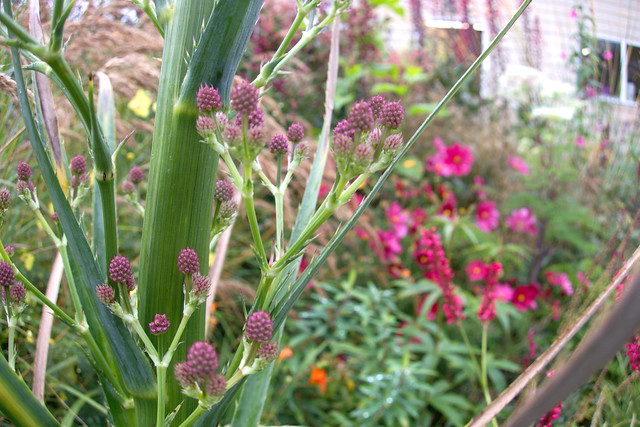
Eryngium pandanifolium
Eryngium pandanifolium needed a frustrating amount of cleanup in spring, and the sprawling clump was reduced to two rosettes. Both are blooming, and I have to admit that once the onerous work is done in spring it requires no attention. Camassias are planted behind the eryngo, which may or may not work. We’ll see next spring.
It’s mid-August, when the south fence disappears under a tsunami of summer growth when viewed from the back porch. (We had the best kind of tsunami-warning experience recently after the record-making 8.8 earthquake near the Kamchatka Peninsula. We packed a few things like food for Billie, left the bags by the door, slept all night, and woke to calm seas and no tidal surge. I’m told that for the 2011 Japan earthquake, there were tsunami sirens and evacuation orders and subsequent damage reported.)
Background shagginess is Acacia pravissima
The fence-topping giants include Selinum wallichianum, which keeps beautiful leaves spring through fall. Angelica stricta ‘Ebony’ has grown shoulder to shoulder with the selinum but has mostly gone to seed by mid-August.
There was an unexpected day of rain last Friday, a really good soak. Plant people were thrilled, the general public irritated. Nothing was smashed down other than the Silver Spike Grass flattening temporarily, restoring when the wind picked up again to dry its plumes, which have left their silver phase behind.
When there was still some bare ground in late spring, I slipped in three Madia elegans, a native annual which had done so well a couple summers back but didn’t reseed. Then the summer tsunami began to build and they were submerged under growth and forgotten. Deploying some clever gymnastics, the madia managed to reach for the light and surprise me with blooms, a much appreciated effort!
A piece of Selinum wallichianum was added to the front of this border too — by next year it will be taller and possibly too much for surrounding plants to handle — I’ll keep an eye on its spread.
Another heroic effort was made by the tiny Persicaria orientalis seedlings squeezed into bare ground in early spring. They too found their footing and shimmied up amongst the pressing growth and are about to bloom — the heart-shaped leaves in the center. Snails leave them alone once the leaves toughen as they mature.
I haven’t split this dahlia yet, planted the first year of the garden
More fence-toppers are sanguisorba and this one very prolific, long-stemmed dahlia ‘AC Rosebud.’ I cut back the bronze fennel by half in early summer. I’m slightly apprehensive regarding this fennel, which is a terrible weed in zone 10, but I had a suspicion its strong stems would support the other giants, and so it has. The acid yellow blooms add a vase-like composition to the scene, but there will be a vigilant lookout for rampant seediness next spring.
Some of the snails make epic garden journeys over 6-feet high, but why?
Second dahlia in back garden is ‘Windcliff Peach’ in a large container
Although I saved seed and planted out young plants this spring, I’m pretty sure Verbascum roripifolium is also self-sowing
I don’t know of a current source for Anisodontea ‘Strybing Beauty’ now that Annie’s Annuals currently doesn’t offer mail order. I moved my remaining plant to the front garden last year, because it always seems to outgrow the back garden. It was beat up bad by winter winds, and only a small rooted piece could be salvaged in spring, which I dug up and babied before planting in the back garden. It blooms year-round in zone 10, so I’ll be taking some cuttings south in a few months.
Papaver somniferum ‘Orange Chiffon’
I have to give up all my Los Angeles preconceptions about growing annuals like breadseed poppies, which are finished in LA by spring but behave much differently in this cooler summer climate. Here on the Oregon Coast, I let a flowering patch go to seed on the east side of the house, and in late June/July new seedlings germinated that are flowering now. And old plants gone to seed also throw up new flowering shoots. I’ve noticed honeywort, Cerinthe major, doing this too, with seedlings germinating mid-summer building into good solid plants for August.
Stachys ‘Hummelo’s first summer, planted last year
Bupleurum fruticosum is squeezing into the path out from the back porch to the garden. For now it gets pruned hard but may have to be. moved
Love waking up to the summer profusion
It might be too much to ask of beschorneria to bloom at the coast
I can easily reach all of my back garden with two hose lengths fastened together, so that’s something to be said for a small garden. (But if I had the money, I’d buy up any adjacent property that comes up for sale, knock down the fence, and probably the house too, and plant it up.) New transplants, stock tanks and pots are watered daily in about 15 minutes or so. In this modified Mediterranean climate on the North Oregon Coast, summer is rainless — except this summer we had rain June 20ish and, two days ago, a full day of it. The heavy soil holds on to a day of rain for a good while.
Anemone ‘Dainty Swan’ started throwing flowers in June but recent rain kicked it into high gear
Truth be told, other than deadheading and watering, there’s not a lot to do in August, and I miss the busy-ness and nurturing of early summer. I notice that I lay in bed a little longer on an August morning than spring/early summer, when I’d be up before first light. Chiltern’s seeds did arrive and some have been sown, and now the shed has flats of seed trays again. I hate it when nothing is growing in the shed! Volunteering at a local veg garden means there’s some winter stuff like kale, leeks, pak choi growing in the shed too. But the chief occupation of August is passively looking, staring, taking it all in.
When grasses catch the August light, it suspends a moment in utter absorption
Easy August tweaks include deadheading flopping Parahebe perfoliata down to budding side shoots, whereupon it regains its stature and blooms again like August is the new early summer. Phygelius reacts the same way if pruned down to side flowering shoots.
Choosing what to deadhead is a very subjective task. Digitalis parviflora’s seedheads make tight, tidy verticals, so I’d rather not cut them back.
The seedheads of dierama are captivating, but there will be trouble ahead with seedlings insinuating themselves where they’re not wanted. In this case, beauty has a price that I’m willing to pay next spring.
Having started them from seed, protected them from slugs, pinched them back, kept them watered since the end of May, it’s not a chore to keep seedheads from forming on cosmos — it’s a mission.
Cosmos are “short-day” plants, so they really seem to jump into action in late July/August when days begin to shorten. As an experiment I’ve sown cosmos seeds in late July to see if they’ll bloom before frost.
The coppery seadheads of Euphorbia ‘Miner’s Merlot’ give it a rusty, mini-hydrangea look. I’m still reluctant to cut it back even though new growth is coming from the base. Just opposite the euphorbia, on its right a pajaroensis hybrid manzanita hits the same color notes, an unexpected collaboration that always satisfies my eye. I’m always looking for a through line in this overplanted little garden.
Foreground Manzanita pajaroensis backed by Euphorbia ‘Miner’s Merlot’
The A in August means agapanthus, just a couple clumps of Windcliff seedlings
The persicarias are to mid-late summer what the geums are to spring/early summer, and they use the adjacent ground well together and appreciate similar growing conditions.
Of the persicarias ‘Summer Dance’ is earliest and most robust. The color differences among the three I grow seem very subtle, hardly noticeable. ‘Blackfield’ is deeper in color, ‘Purple Spears’ is more the usual crimson.
looks gloomier now without the Aralia ‘Sun King’
Aralia ‘Sun King’ was great as the garden found its legs but began to threaten important woody plants like Stachyurus salicifolius. Removing the aralia was a monster job, so it was definitely time to curtail its spread. A couple of summer plants also had to be moved before bloom or risk being engulfed forever, including Heliopsis ‘Burning Hearts’ and a Helenium ‘Summer Cinnabar.’
Scabiosa ochroleuca and Helenium ‘Sahin’s Early Flowerer’ hitting their August stride
Crocosmia ‘Limpopo’
Allium ‘Millenium’ makes August look fresh. Seedheads of Linaria ‘Peachy’ were cut back, bringing a small rebloom
Digitalis ferruginea leans on cassinia and pearly seedpods of Crambe maritima
the mountain mints rise up from their earlier quiet anonymity to become important, if monochromic, contributors to August. Calamints lining the path are also just starting to bloom. It’s a pollinator corridor now!
mountain mint Pycnanthemum muticum
Sinopanax formosanus
I’m thrilled that the young Sinopanax formosanus survived the transplant in April. Sandwiched in the middle of a Bupleurum fruticosum and Senecio monroi, something had to give. I liked it’s protected spot slightly under the overhang, and the move near the back fence may lessen its odds over winter, but it was clearly going to be too tall. I really should move it to the protected east side of the house, which is just now getting planted up.
When establishing woody plants in this zone, I always assume that there will be failures — and sometimes, surprisingly, there are no failures, everything flourishes, and once again I’ve obviously planted too closely. Now the adjacent Acacia pravissima is flourishing, and the sinopanax is once again squeezed! But one hard winter and another ice storm could change everything.
Corynabutilon vitifolium — flowers are blue-lilac and tiny, about the size of a globe mallow, but the leaves are fabulous in color and feltiness. Its ultimate attributes may be limited to being a 6-foot nonflowering cutback shrub with great leaves, but it’s tentatively still on trial depending on how it comes through next winter
The narrow east side of the house, where the previous owner grew strawberries and vegetables, is for me an overflow utilitarian area. Some vegetables, some orphan plants, some plants on trial. The borders on either side of a central grassy path are narrow and backed by either the house or the east fence — some of my least favorite conditions to plant. I think in deep borders! But I did notice some of the orphan plants are thriving, so I’m beginning to take this area a little more seriously.
on the east side of the house, corynabutilon, Hedychium ‘Tara,’ Kniphofia hirsuta
The kniphofia which grew too large for the back garden was sold as K. hirsuta, supposedly one of the smaller kniphofias. It’s the most aloe-esque kniphofia I’ve encountered. It bloomed in spring, but it’s that gorgeous arching urn shape that is the main attraction. I’m curious how it will tolerate a harder winter than last year’s and whether it can be reliably incorporated into more prominent planting.
I love the flowering oreganos and somehow ended up with none this August. A couple were found local (‘Rosenkuppel’) planted in a pot with the grass Helicotrichon sempervirens. I repeatedly planted this grass in zone 10 and it repeatedly failed. Maybe a cool zone 8/9 is the trick.
tiny flowers of Fuchsia ‘Hawkshead’ provide scale for big leaves of Bergenia ciliata
isn’t this charming as hell? Rhodochiton threading through cassinia
One of the big daisies of August, Helianthus ‘Lemon Queen,’ opened its first flowers today. Now that the acacia is taking over this corner, all or part of the helianthus will be moved to the narrow borders on the east side, which is filling up rapidly.
in the foreground, fluffy Pennisetum villosum, considered invasive in California
This summer seems windier than most I’ve experienced here. Only in July have the winds finally dialed down from fierce to breezy. (July also marks the end of the disgusting but mostly harmless reign of the spittlebugs too.). I imagine that growing grasses in gardens with summer rain might result in repeatedly frustrating scenes of flattened chaos, so they might not be suitable for every garden (or taste). Here, one of the few perks of a rainless summer is how I get to indulge my appreciation for them: miscanthus, deschampsia, molinia, calamagrostis, sesleria, stipa, achnatherum, chionochloa, festuca, and the sedges too.
Silver Spike grass with Veronicastrum ‘Fascination’ and cosmos that filled in after removal of Joe-pye weed. Sanguisorba ‘Red Thunder’ upper right, a swirl of embers in the wind
I’ve never been a fan of turbulent winds, but the swaying grasses are slowly making a convert of me. (Marty has a sailor’s temperament, so the wind excites him whereas I’m inclined to hide.) Now that July has reduced the strongest afternoon winds (is it a temperature gradient thing?), I like nothing better than moving a camp chair around the garden all afternoon for the best views of the action. Two hummingbirds have found the garden and are regular visitors. The buzzing activity seemed low to me in June, but the garden has really come alive in July.
The two big clumps of Silver Spike grasses on the left will need dividing and refreshing next spring. Yelliow flowers are ‘Ruby Streaks’ mustard gone to seed
Eryngium pandanifolium pushing skyward, Persicaria amplexicaulis ‘Summer Dance’ just coming into bloom foreground
except for staking the sanguisorba, all else is self-supporting. The cirsium and some geum are having a rebloon/continuing bloom. Persicaria polymorpha looks like a cross between a giant aruncus and a flowering grass that I love as a months-long backdrop
explosion of wind-driven embers on Sanguisorba ‘Red Thunder’ — the sanguisorba and dahlia are the only plants staked
Sanguisorba ‘Red Thunder,’ of all the plants in the garden, is most susceptible to the wind. (Even the roof-high thalictrums were unbowed by really strong wind.) This year, new growth on the sanguisorba was selectively cut back in May/early June, and it was lightly supported with bamboo stakes, and that seems to have helped a lot. It does lean but stems don’t break. Stems overly intrusive on neighboring plants are cut for vases where it lasts for weeks.
seslerias, Chionochloa rubra, Stipa gigantea on the left, Rhodocoma capensis on the background far right, Pennisetum villosum foreground right
Container of cosmos amid planting of libertia, eryngium, Senecio monroi
Cosmos has such a light footprint, doesn’t take up much room (unlike dahlias) and handles wind well. Two kinds were sown, ‘Apricotta’ and ‘Rubenza.’ The former was good last year, but germination this year was poor and the plants markedly weak growers compared to ‘Rubenza.’ Cosmos blooms well in containers as well as in the ground. I sow seeds in April and grow them to blooming size in containers, which saves disturbing the early summer garden as they bulk up, and a few are planted in the ground if space opens up (as when the Joe-pye weed was removed). Most pots, 3 plants to a 12-inch pot, are dotted around the garden and become quickly concealed by summer growth.
Eryngium paniculatum
Hebe recurva at the base of Eryngium paniculatum
Eryngium agavifolium
Eryngium variifolium
late-appearing hesperis with Eryngium ‘Big Blue’
cosmos sown in April just now starting to bloom, their ferny leaves disappearing into Selinum wallichianum. Slim footprint for a small garden, light in structure and leaf. White flowers are an olearia, possibly O. moschata, that replaced an over-large phormium
Cosmos ‘Apricotta’ and ‘Rubenza’
One of just a couple plants of ‘Apricotta’ to succeed this year
Dahlia ‘Windcliff Peach,’ seed strain from ‘Forncett’s Furnace’ — not too bulky, long stems. In a container but I’ll probably move it to the garden when I split up and divide the Silver Spike grasses
dierama and Stipa gigantea make a swinging duo in afternoon breezes
dierama with variegated figwort, Scrophularia auriculata, and Persicaria polymorpha
July garden. Rusty spikes are Digitalis parviflora. Digitalis ferruginea is just starting bloom in mid-July.
a short side path for Billie was sacrificed to plant Cimicifuga ‘Hillside Black Beauty’ — an impromptu decision determined by the cheap price of the snakeroot on summer sale
Teucrium hircanicum gets going in July
joining penstemon, Verbena ‘Bampton,’ Scabiosa ochroleuca and Helenium ‘Sahin’s Early Flowerer’ start blooming in July
Salvia patens ‘Cambridge Blue’ — all my salvias wait until July, tho I’m sure there are kinds that would jump into action much sooner
Salvia bullulata ‘Pale Form’
Angelica sylvestris ‘Ebony’ reaching 5 feet
Dianthus barbatus ‘Monksilver Black’ starting to flowerr in July, much later than the other sweet williams which have all been deadheaded
Francoa appendiculata in front garden
checking for tetrapanax shoots daily after removal of the mother plant, I somehow missed a 3-footer, which is being trialed it in a pot
Even on the worst of the early summer windy days, hanging out under the overhang was a safe bet for some peace and quiet, and is Billie’s preferred place to lounge. Hope July is treating you well. Take care, AGO
Just one seed of this angelica germinated out of a packet sown February 2024, and to be honest, one angelica is all I have room for, but a couple of backups for insurance would have taken off the pressure of losing it. I’ve read angelica seed needs to be sown as fresh as possible, so I should have sown it when purchased June 2023. After this bloom goes to seed, I’ll get a bunch more plants started by fall, hopefully, from its very fresh seed.
It’s a big biennial, easily 3′ across. What a looker! Snails weren’t interested, so it’s been a flawless study of finely cut compound leaves in moody purple. And enthralling to watch the flower sheath swell taut, growing as big as a fist the past several days until the crown of the lacy umbel broke through this morning. The ultimate height has been estimated to be as much as 6 feet. The flower will be lighter in color than the leaves. For a dark purple flower, Angelica gigas is what you want.
spreading its wings in late spring
Biennials are a little tricky as far as timing, and unless they reseed for you, they can be one-off novelties. So remembering to sow biennials for next year now, in early summer, is the tricky part. Hesperis, lunaria, and Digitalis ferruginea are already established reseeders. I’m about to send off a seed order for a few more biennials including Verbascum phlomoides ‘Spica’ and some selections of Dianthus barbatus like ‘Sooty.’
engulfed by July but holding its own
I love the seed selection at Chilterns Seeds in the UK, which works if you obtain a Permit to Import Plants and Plant Products from the Dept. of Agriculture. My permit was issued in 2022 and is good until October 2025. Like everything else now, there’s uncertainty whether this permit will be honored and how easy it will be to obtain a new one. Getting this one online was a breeze, a matter of a few weeks until issuance — the old Talking Heads song “Don’t Worry About the Govt” comes to mind a lot these days (“Some civil servants are just like my loved ones…”)
A few more early July happenings.
Persicaria polymorpha makes a good backdrop for Lobelia tupa
Phlomis x margaritae may bloom next year, but if not, that’s okay too.
wonderful leaves
another complicated emergence of a flower with Centaurea macrocephala aka basket flower
Dahlia ‘AC Rosebud’ has topped the fence again and mingles with Sanguisorba ‘Red Thunder,’ also a 6-footer. It was an alternate from a local dahlia grower, but I keep it because it’s sturdy enough to deal with the fierce daily wind! Only just in the past few days of early July have the roaring afternoon winds failed to appear, and it was bliss working in the garden all day.
mystery cherry pink dierama. Carl Thunberg, the “Father of South African Botany” is credited with the discovery of Dierama pendulum in the 1770s
The SoCal garden churned through a lot of attempts at growing dieramas. I’d figure they’re South African, I’m zone 10, we should get along famously. So many plant fails are due to faulty assumptions. Matching growing zones is only the beginning of the investigation as to whether conditions are suitable. Dieramas are not for hot dry gardens but come from cool mountainous regions in southeastern Africa. The fact that the famous Slieve Donard hybrids were developed in Northern Ireland says a lot about their preferred growing conditions. Hot and dry conditions in Northern Ireland must be thoughtfully provided, whereas in Los Angeles those are the brutal default conditions. (Simply compare the latitudes of Northern Ireland and Los Angeles for the strength of sunlight, something I’ve only recently started to take into account.) Novices make many such mistakes, but still trial-and-error can prove the astonishing range of plants and bring surprising results — just not, in my experience, with dieramas.
this Slieve Donard dierama appeared at a SoCal nursery and was brought up to Oregon. This strain of dieramas was developed mid 20th century at their namesake nursery in Northern Ireland, named for the highest peak of the Mourne Mountains. I’ve read about this strain since forever, nice to see it bloom in the Oregon garden. The darker colors steal all the oxygen, but this silvery number need not apologize, I love it.
zone categories are based on average minimum winter temperatures. Other factors like heat and rainfall were not originally given proportionate consideration
In fact, a theory I brought north to the Oregon garden, that growing conditions here would suit plants that are also happy in Ireland and Northern Europe, has been borne out. Here at the Oregon coast, dieramas bloom from a small size, often the first year they are planted out. No struggle, no gnashing of teeth.
From Australia and so far winter hardy here, Acacia pravissima speaks to the remarkable range of potential growing conditions tolerated by plants, which only trial-and-error can discover
Many faulty assumptions were also absorbed by the mostly photo-less books read in my formative garden years by plants people who were also great writers like Jekyll, Sackville-West, Russell Page, and Lloyd — when they referenced plants for hot, dry areas, I ignorantly assumed it as a ringing endorsement for Los Angeles gardens! British garden writers already had centuries of garden culture at their backs to lend that authoritative, confident tone to their writing. The Empire had been sending out explorers and botanists as far back as 1768, when Joseph Banks joined Captain James Cook’s voyage to observe the Transit of Venus. And all those plant specimens were brought back to the very propitious growing climate of the roughly zone 8 British Islands, which has a lot in common with the climate of the Oregon Coast.
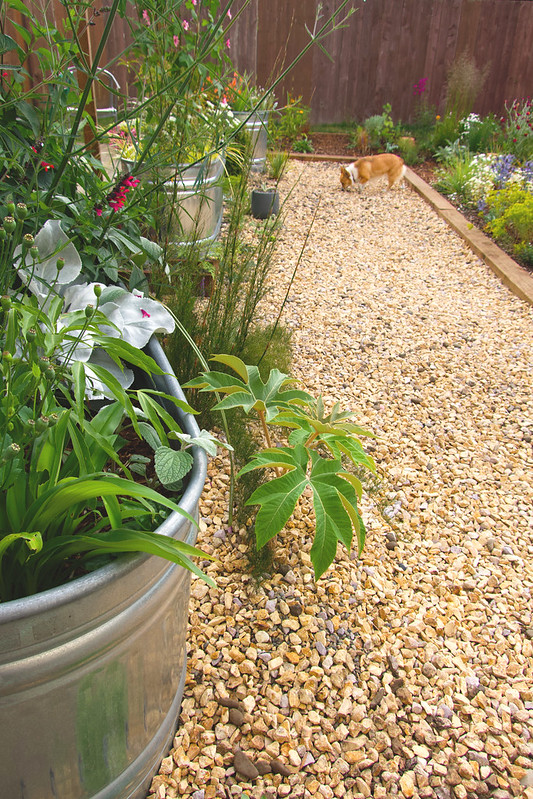
early spring 2022. Rhodocoma capensis, the Cape restio from the Cape Province of South Africa, has been planted at base of far left stock tank. That generous graveled area has shrunk considerably the past four years.
What I’m realizing attracted me in those formative years reading about mostly zone 8 gardens was a framework for thinking about gardens, and the confident inclusion of selections and representations and, most importantly, sequences and chronology of natural cycles in this framework. The relative predictability and structure of planning for spring, summer, fall, and the creativity and purpose unleashed by the hard limitations of frost dates.
Digitalis parviflora beginning to color up. Herbaceous plants thrive here and assume astonishing shapes in a matter of months.
That whole psychological notion of the “summer garden” being this rare, fleeting phenomenon you have to grab with both hands, this is what was imparted and took hold in my garden imagination. And that’s what I’ve experienced in the Oregon garden. (And abandoning those misconceived notions is when I really began to explore the potential of the little zone 10 garden in Los Angeles.)
July 2022 — a young tetrapanax with world-conquering ambitions removed spring 2025. Rhodocoma just behind. This stock tank now holds a Darmera peltata, Eucalyptus ‘Baby Blue,’ Corokia ‘Sunsplash,’ Anemanthele lessoniana — and remnants of the expelled tetrapanax continually find their way up through the drain holes
the path through the gravel is no more than a dog track now. Rhodocoma capensis background on the right, over 6′ now. The restios perform very well in zone 10 too.
shimmering intergeneric hybrid Ozothamnus x cassinia in bloom
stock tank at eastern end is almost completely concealed by plants now. Originally planted with cassinia, manzanita and a restio, the latter pulled out this spring
Shimmering even harder as it edges into bloom, this Cassinia leptophylla ssp. fulvida was found at a SoCal nursery. Like ozothamnus, it’s from Australia/New Zealand. I rarely see it available. Rooted cuttings have been planted in the SoCal garden as well as the Oregon garden — don’t ever want to lose it! One of the original stock tank plants with Arctostaphylos ‘Sunset’ which, in a container, seems to tolerate summer water.
more small stature plants filling in the rocked area — Linaria ‘Peachy’
Looking for a purple-leaved sedum without pink flowers led to Sedum ‘Conga Line’ found locally with flowers on the buff/peach spectrum, planted this spring
still taking fliers on odds and ends like this form of Campanula punctata but generally avoiding the classic scene-stealing genera that grow so well here like peonies, roses, maples, rhodies, clematis, and mostly focusing on low-key textures and sparkling seasonal incidents that contribute but don’t dominate. A kind of modified chaparral approach that’s a hangover from 30 years of gardening in SoCal.
Eryngium varifolium has been through several winters
The asphodels hit all the marks, so good in leaf, flower and seedpods. (Still need to paint the fence!)
Symphytum ‘Axminster Gold’ beams amongst grasses
Newly planted this spring, Symphytum ‘Axminster Gold’ has proven robust enough to co-exist with grasses, not an easy niche to fill. Pinched back when planted, it’s branched out and muscled its way up and between the Silver Spike grass, Achnatherum calamagrostis.
side view of Silver Spike grasses with Penstemon ‘Dark Towers’ in foreground
Alstroemeria ‘Third Harmonic’ is also strong enough to find its way among grasses
Reading brought me first to gardens, not photo-heavy books, magazines or video how-to’s, and the idea of a discrete “summer” garden took on a mythic, Brigadoon-like quality for me. The Joe-Pye Weed was growing roughly center of the photo, in front of the large grasses
I mentioned on June 17th that Joe-Pye weed would eventually have to be moved, maybe next spring. But the idea became embedded like a sliver, and removal of the eutrochium was accomplished within the week. The enormous root ball was not easy to extricate, and because of its extensive roots the entire area was very dry, even after a good rain we had on the 20th of June.
Alongside Stipa gigantea, Geranium robustum from Secret Garden Growers this spring, borderline hardy, silvery fine-cut leaves, politely hoists itself up and into surrounding plants
yelllowy-chartreuse spires with Digitalis grandiflora and Phygelius ‘Strawberry Blonde’ with foreground Podocarpus ‘Mood Ring’
Digitalis grandiflora which I may have previously referred to as D. lutea, which is smaller and without the speckled throats. From the excellent Digging Dog Nursery on California’s North Coast near Mendocino.
Phygelius ‘Strawberry Blonde’ showing that uniform habit of growth phygelius achieves when cut back after winter
Very cold/wet tolerant Agastache auranticus selection by Xera Plants possibly ‘Mandarin Dream’ growing in a large metal trash container at the east end of the overhang. The Fritillaria persicara also in this container did not return after winter, which I’ve read is typical. Too expensive to treat as tulips though!
Rhodochiton atrosanguineus vine seems happy, blooming from a young size
“breadseed” poppies are spring bloomers in SoCal, lasting into summer here. This ‘Orange Chiffon’ strain came true from volunteers this spring
Amazingly, Echeveria agavoides has survived several winters here, thriving in this garden as well as in zone 10
This certainly turned out more long-winded than usual! And on to July. More soon, AGO.
shrub-like, fence-topping herbaceous Persicaria polymorpha with evergreen Metapanax delavayi on the right
Studying the back garden from under the overhang this morning (which has an electrical outlet, so typing as I study), I like the big blocks of growth I’m seeing, but it’s easy to predict more needed interventions ahead. The planted area of the back garden comprises roughly 625 square feet, all south facing.
Gillenia trifoliata on lower left, Stipa gigantea leanning in from left. Euphorbia stygiana just visible far right
The herbaceous giants include the sanguisorba, persicaria, joe-pye weed, Lobelia tupa, Stipa gigantea, Euphorbia stygiana, gillenia, Silver Spike grass (Achnatherum calamagrostis), interspersed and fronted by the more mid range in size like the early-blooming geums and sesleria and deschampsia grasses. I’m nervously aware that any of the giants could become the predominant players, squeezing out all other details. But so far, this June, everything is still holding together.
Gillenia trifoliata is at least 4×4′ this year
What drives me crazy in winter, when it all goes away and becomes an invisible garden, is one of the strengths in the growing season, being able to play with the shapes and shift things around when proportions change.
Before Jiune, evergreen Euphorbia stygiana was the largest presence in the garden, approx 5×5 after a spring pruning to keep it out of the path. Now, Persicaria polymorpha conceals it entirely when viewed from the overhang — above photo taken from the fence toward the house. Kniphofia thomsonii dwindles as the metapanax gains size and shade canopy– most of the kniphofia have been moved elsewhere
some of the Kniphofia thomsonii was moved to the space vacated by the tetrapanax and more clumps moved to the front garden
With most of my gardening life in zone 10, where it’s too warm for herbaceous plants to achieve dormancy and build up strength to return, (and way too dry), it’s these plants that I’ve always wanted to experience. Coupling that with a propensity for big shapes, big plants, and an appetite for an exihilarating rush of growth means that already lots of plants are in danger of being crowded out in this garden’s fourth summer.
Patrinia scabiosifolia in bud July 2023
For example, the patrinia planted between the shrub-like persicaria and Sanguisorba ‘Red Thunder’ is later to leaf out than those two, and as the latter mature early into big clumps, the patrinia dwindled from the canyon effect. It was moved this spring to a place vacated by the aptly name Dahlia ‘Camano Sitka,’ tree-like in size and vigor, which created its own canyon issues for surrounding plants. Those are just a couple examples of the many boundary disputes resolved this spring.
joe-pye weed to the right of the orange geums, Lobelia tupa behind the frothy white of Veronica catarractae. Both have a lot more growing to do!
Veronica cataractae has an invaluable shrubby presence early in the season and through summer
Deferred for now is the question on whether the joe-pye weed ultimately has to be moved as it pushes out on neighbors north, south, east and west. Either it gets shifted or the next-door Lobelia tupa moves. It will take the joe-pye weed much less time to rebuild than the lobelia, so the investment of time is another consideration.
view from the back fence toward the house, with Silver Spike Grass and Selinum wallichianum
The planting prominent in early spring, in the border closest to the back fence, cirsium, angelica, symphytum, hesperis, camassias, becomes concealed from the view from the overhang as the summer growth progresses. There’s about a 4-5 path between the back border and the fence.
Diatnthus barbatus ‘Oeschberg’
As the bloom of the orange geums becomes less profuse, June brings the flowering of the sweet williams I started from seed a few years ago. Described as biennial or short-lived perennial, clumps of the dark seed strain ‘Oeschberg’ return fattened up in spring, with no seeming intention of dwindling.
Burgundy eye of Halimiocistus ‘Merristwood Cream’
These are famous cut flowers, so they last long in the garden too and pick up like alliums all the other burgundy in leaf and flower I seem to favor.
sweet williams, halimiocistus and penstemon bring a corner into early focus in June
Most of the clumps of sweet william have been shifted to the front garden, moved to make way for newer things in the back, but they are invaluable for threading a strong line among grasses beginning in early summer and giving the impression that, after a slow spring, the garden is on its way. I’m thinking of trying the white strain too. The front garden acted as an escape valve for the overplanting in the back, but no more, both are full to capacity.
Penstemon ‘Mockingbird’ a hybrid bought at a recent plant fair from its nursery of origin Miller’s Manor Gardens Nursery
astrantia seems to be coping with increasing shade under the metapanax
The big shapes may dominate but smaller scale planting fills containers and the graveled area.
a week-old photo of the asphodels, which are still showing color today, a long season of interest. Tall spikes are now up on Eryngium agavifolium on the right
There’s very few local gardens to study, though I do see peonies, roses, and oriental poppies in bloom now, and the invasive gorse (Ulex europaeus) gleams on the coast and in clearcut areas.
Climber Solanum laxum remains evergreen in a mild winter and has been cut back to keep it in bounds and climbing upright. A Chilean Glory Vine survived the winter and is threading its way up too. A stock tank with Darmera peltata is concealed by the plantings from this view, which include Rhodocoma capensis that gets thinned every spring
Long Beach zone 10 garden end of May 2025 (my phone photos!) after a full day of weeding and watering. The red-leaved Euphorbia cotinifolia hadn’t leafed out yet when I left in early April.
I spent two days at the end of May in Long Beach (garden USDA zone 10), readying the house for some friends’ upcoming stay. (The second day, May 30, topped 95F — what a homecoming!) The profligate weediness in the garden continues, with couch grass encroaching everywhere, and that’s after diligent weeding all winter. Neighbors ruefully report this new weedy state of affairs in their own gardens too, and we all lament wtf? Whatever the cause, the only hope is to stay on top of the weeds until the cycle hopefully breaks and the supply of weed seeds is exhausted.
In my absence since early April, the Minoan Lace, Orlaya grandiflora, had a banner year, and multiple clumps were weeded out, as were most of the spent Poppies of Troy, Papaver setigerum. And even though the mother plant is gone, I noted quite a few bocconia seedlings too near the back wall — too many!
The performance of self-sowing plants has also been incredibly robust — I’ve never seen so many Orlaya grandiflora in bloom here before. All the poppies were pulled and only a few orlaya left to bloom and reseed.
prominent summer actors are now kangaroo paws and Sonchus palmensis, which had many bloomed-out trusses trimmed but more keep coming.
To those of you with hand-made gardens, you probably also know the where/when/how/why of every plant in your garden, why choices were made and how it comes to look as it does at this moment in time. It is a process unlike anything else, engaging parts of the brain and heart like no other endeavor I’ve pursued. So shuttling quickly between two hand-made gardens at the near-height of their seasonal expression is disconcerting to say the least. (Aloe lukeana’s elongating bloom spikes will flower in my absence!) Both gardens excite me in very different ways, and both are hard to leave.
Pelargonium multiradiatum
Incredibly, a small collection of potted species pelargoniums survived months of neglect, so I decided to increase their odds of survival by planting them in the garden among succulents, whose water needs are most similar. P. multiradiatum and P. glaucifolium have both flourished and expanded into big clumps, with good leaves and tiny flowers that don’t steal any thunder from the succulents but just add some leafy richness (and smother weeds).
The newly planted leucospermum on the right got a much-needed long drink of water
After a two-day train trip back to Oregon, Mitch took the following photos of the zone 8b garden:
June 1, the summer garden takes shape. Unlike the architectural zone 10 garden, the zone 8 garden is mostly shapeless after the winter cutback until late spring. There are a lot of evergreens, but the percentage in the back garden leans herbaceous.
beautiful and evergren Acacia pravissima
a nice moment, everything relatively in scale before the big surge of the summer crowd like joe-pye weed and Lobelia tupa
Plants like Centaurea macrocephala I admire for their buds as much as their flowers
Parahebe perfoliata at its best when it starts with fresh growth every spring, most old growth cut back late winter
P.S. Please don’t read further if you’d rather avoid politics. It just seems bizarre not to mention the latest outrages of these dangerous times. Take care! More soon, AGO
(Shout out to Oregon’s Attorney General for leading the lawsuit challenging emergency tariff powers, which was upheld by the U.S. Court of International Trade, though currently stayed on appeal. Back home, the Port of Los Angeles is at half capacity. My grandfather died on those docks, my father, uncles, cousins and Marty all worked their entire careers at the port. A million Los Angeles County jobs derive from port-related activity. It is the economic engine of both Los Angeles and Long Beach, and it is sputtering under the tariffs. And the federal assaults on Los Angeles don’t stop, with the latest being the excessive and illegal show of force over immigration protests — but California is apparently the wrong color, on so many levels, so an easy, vengeful target…)
Two divisions were spilt off from this main clump of Cirsium ‘Trevor’s Blue Wonder’ and replanted. With the help of overcast skies, they’ve settled in and have already started to bloom. The cirsium, geum and hesperis are all early arrivals that give April/May a sense of occasion. The geum and hesperis are usually finished by July, but last year the cirsium threw flowers all summer. And they all love this heavy, wet soil. Hesperis is a biennial that reseeds, similar concept to a Verbena bonariensis for spring.
Believe it or not, I was worried I might miss the tail-end of the rainy season when returning to the coast in early April. I was hearing reports of a dryish winter, and I seem to remember 2024’s summer dry season commencing at the end of April. Instead, to my great joy, May has provided the best drizzly, overcast skies for shuffling and resettling plants. And I got the rain fix I needed — Marty is not quite as appreciative of the wet weather.
Anthriscus ‘Ravenswing’ is another strong early presence in April/May that knits together surrounding emerging foliage
Another good plant that was disturbed in its spring foliar glory is Filipendula ‘Red Umbrellas.’ I’ve been brooding over the lack of softly mounding shapes this spring, which this filipendula does so well. The main clump was dug and split into thirds, and once again rainy May worked its magic on the transplants.
Eryngium guatamalense. Until Windcliff, the only source was from Europe. Jimi Blake grows it at Huntingbrook in Ireland, where his soil and climate conditions strike me as very similar to the Oregon coast — I had to try it!
Knowing that Dan Hinkley would be coming to the coast to give a talk in April for the Hoffman Center of the Arts’ Wonder Garden, I assumed he would be bringing some Windcliff plants for the plant sale also in April. But he wasn’t. No idea why I assumed this. So turns out my request to Ketzel to ask Dan to bring Eryngium guatamalense could be construed as very pushy because there wasn’t an overall plant sale order. Incredibly mortifying. Yet they laughed and wouldn’t even let me pay for it. Oh, the shame (but oh, the excitement to see if it likes my garden!)
Eryngium ‘Big Blue’ has been reliably returning since 2021.
For me Dan’s talk was a fascinating continuum of the (to me) familiar story of his wildly successful nurseries, plant hunting, and gardens. I knew Windcliff suffered severe damage from winter 2024, and a large section of it was solarized in anticipation of replanting. To hear Hinkley admit how things began to go “sideways” at Windcliff due to septic tank issues, winter damage, and how he managed to become excited all over again from a rogue patch of volunteer opium poppies — for me it answered a lot of questions I had after visiting Windcliff in summer 2024. I mention this because I did hear one comment from someone perhaps not so familiar with the Hinkley chronicles, and his rollicking, often droll speaking style, who wished there was more talk of individual plants. (Which strikes me as expecting recipes from Anthony Bourdain.) But the talk seemed very enthusiastically and warmly received. Loree of Danger Garden gives the next one on May 30 — unfortunately I’m out of town. Go Loree!
Eryngium agavifolium looks strong after winter. Nearby Morina longifoliia bloomed well for a few years but did not return this spring.
Digitalis ‘Honey Trumpet’ from the Wonder Garden plant sale, discovered by Xera Plants. Digitalis purpurea would be another early presence for spring but I’m just not a fan, but I do like the rusty summer foxgloves and am trialing Digitalis lutea,
Also strong in May, Lysimachia atropurpurea. Unfortunately it doesn’t appear to reseed so new plants were added in April.
Finally, a little leggy, but Crambe maritima is in bloom, a first. Hopefully the pea-like seedpods ensue.
new this spring Deschampsia ‘Tatra Gold’
front garden, view east from the open gate
The front garden has been both receiving and supplying plants in the ongoing shuffle. All the nonblooming ‘Helen Von Stein’ lamb’s ears have been moved from the back garden to the front. They thicken up too fast in the back garden and are more useful where they will be kept drier over summer.
front garden Cistus ‘Jenkyn Place’
Sobaria sorbifolia has a similar effect to Rhus typhina but purportedly less invasive
Siberian iris classic ‘Caesar’s Brother’ was a Wonder Garden castoff
I’ve tried various small euphorbias like ‘Dean’s Hybrid,’ ‘Blue Haze,’ but this is the one I’ve been waiting for, ‘Copton Ash’
late April 2025 after a couple weeks of cleanup mostly on dry days. Though I did grab Marty’s foul weather gear from his LA harbor days and suited up to work in a rainstorm for a full day — the drive to spring clean the garden is strong!
I worked for 20 years in a profession famous for repetitive stress injuries to the wrists (court reporting) and never suffered from one and could only wonder what it must feel like to those having to wear wrist splints as part of daily attire. Now I wonder no more. Cutting back the garden since arriving in early April, the right wrist really started to feel it. It’s back to normal now, but that marathon spring cutback session needs rethinking. While the pain memory is still fresh, I thought some notes on tuning up this spring garden might be helpful to review next spring, hopefully prompting some workarounds. (For comparison, the cleanup work we put into the Los Angeles garden last October was exhausting, but no one particular muscle group was affected more than the other — everything hurt!)
asphodels are this cool with no attention at all
another flawless presence in spring, Polemonium ‘Golden Feathers’
I was resigned to the libertias performing as tidy foliage plants — finally some flowers!
compact form of Brachyglottis greyi joined by flowers of Euphorbia ‘Miner’s Merlot’
late April 2025 feels like the garden is an orchestra, chaotically tuning up. Between my efforts to cut back and clean things up and the afternoon wind blowing out the chaff, we’re getting there
backdrop with new wood of the fence repair. On the right, Stipa gigantea and dierama both require labor intensive tidying.
Dierama needs careful cleanup due to its asymmetric and akimbo growth pattern that juts out stalks awkwardly. I sacrificed some summer blooms to lasso it back into a more vase-like outline and trimmed a lot of its ratty blades. (The Olearia x mollis ‘Zennorensis’ directly behind the dierama surprisingly flourished, but the two shapes fought each other. Which one to move? Not wanting to set back blooms on the dierama, I opted to move the olearia to the front garden, which has a mostly evergreen presence.) The giant restio Rhodocoma capensis was thinned a lot; arguably, it needs a bigger garden than mine, but even reduced and thinned it has a strong presence, so it stays for now. And it definitely has more breathing room now that the tetrapanax is gone — above ground anyway!
The removed tetrapanax was sited roughly where the round tank is now temporarily situated, I’m finding and removing new shoots of the tetrapanax daily. Rhodocoma capensis just behind. Euphorbia characias seedlings are progeny from the mother plant in full bloom this spring that had grown thin and woody so was removed . Great temporary plants for a new garden. A division of mountain mint, Pycnanthem muticum, replaced the euphorb (roughly between stipa and dierama),
Something Ketzel Levine said at Manzanita’s Wonder Garden plant sale last weekend stuck with me. Some of us volunteers were looking at a congested clump of Eryngium paniculatum, and our fearless director said sometimes it’s best to dig up and divide a mature clump rather than waste time trying to clean it. Now, to me, a mature clump of anything is a huge asset, capable of producing more blooms, and some tap-rooted plants don’t take lightly to being divided, but the general point is well taken. The giant eryngo in my garden, E. padanifolium, becomes a congested mass of spiky leaves, very scratchy cleanup work. I opted for a shortcut this week and removed most of the rosettes, leaving the largest. And as for Stipa gigantea, this evergreen grass needs a lot of tidying and cutting back of old bloom spikes, and I’ll most likely divide it next spring and start fresh –.I wouldn’t be without it. The seslerias and deschampsias also need extensive raking and trimming.
Chionochloa rubra, practically perfect in every way, needed no cleanup at all, fronted by one of the many eyrngos in the garden
Achnatherum calamagrostis, camassias, and Symphyttum ‘Axminster Gold’ planted in April. This grass needs only the old flower spikes cut back
Between the two clumps of Silver Spike Grass grew one of the many divisions of Succisella inflexa spread throughout the garden, a fizzy pollinator-attracting perennial that adores growing conditions here and quickly extends to sizeable clumps. With pale lavender, knautia-like flowers, it was a boon to the new garden but becoming an aggressive spreader. Only one clump remains. Symphytum ‘Axminster Gold’ was found at Blooming Junction, a good nursery an hour and a half away. (We made a couple trips to a nearby mechanic to get my Mini Cooper checked out, so there were some unexpected plant shopping opportunities. Garaged all winter, nevertheless, upon startup the Mini had a fit and was throwing multiple computer codes, and the windows, turn signals and windshield wipers wouldn’t work. A hefty repair bill for the Mini at 14 years old, 100,000 miles, but we’ve no interest in car shopping at the moment!)
from left, Eryngium padanifolium, Euphorbia griffithii, camassia, geum, backed by Silver Spike Grass and comfrey
The comfrey is a much better background for the camassias than the nondescript green leaves of succisella, and as it gains size and spills over the riser it will help conceal the dying camassia leaves.
Euphorbia griffithii
Metapanax delavayii loved the relatively mild winter
Overall, since breaking ground in October 2021, more plants have survived than failed, so there’s been lots of digging and relocating this spring. (The only transplant I fear may not survive is Sinopanax formosanus, which flourished in a location that was inappropriate for the size it was attaining, so it had to be moved in any case.) Regrettably I did remove Hebe parviflora var. angustifolia, and will miss its glowing willowy presence when at its peak of summer/fall beauty. As it grew to over 4 feet, however, its scruffy spring presence became harder to ignore.
Hebe ‘New Zealand Gold,’ Phlomis monocephala and Cassinia x ozothamnus
I expected a similarly scruffy appearance from the stock tank beschorneria, but the buffering effect from the nearby Cassinia x ozothamnus may have saved it from winter’s worst. See, it pays to overplant!
Angelica sylvestris ‘Ebony’, one plant survived from a packet of seed. Wonderful spring presence. If it blooms in late summer, fall would be the time to collect the seed and sow it fresh for more plants next spring
also new to the garden is another dark-leaved plant for early spring presence, biennial Anthriscus ‘Ravenswing’ –known to reseed true to type
The anthriscus share ground with a young Stachyurus salicifolia, melianthus, Aralia cordata ‘Sun King’ and a nicely maturing Thalictrum ‘Elin’ just in front of the stock tank.
Thalictrum ‘Black Stockings’
Also here, Thalictrum ‘Black Stockings’ can’t hold a candle to the majesty of ‘Elin’ (imho). Digitalis ferruginea is reseeding almost too prolifically here, and I’m trialing a couple Digitalis lutea too.