School Gardens

The April 2010 issue of The Atlantic, which I grabbed for haircut reading yesterday, published letters to the editor (“Grading the Gardens”) in response to their January/February article by Caitlin Flanagan entitled ‘Cultivating Failure.” Readers of Gardenrant might remember the dust-up this piece incited on January 22, 2010.

Briefly, Flanagan argued a causal link between what she deems useless school activities, like including a couple hours of gardening a week into the curriculum, foisted on schools, she feels, by misguided liberals, and a decline in student academic performance, that including gardening in the curriculum “thrust[s] thousands of schoolchildren into the grip of a giant experiment, one that is predicated on a set of assumptions that are largely unproved, even unexamined.”

For those who found the Garden Rant discussion of interest, the letters to the editor further extend that discussion. Letters to editors have become one of my favorite forms of reading, both online and in print. Eric Schlosser (Fast Food Nation) and Delaine Eastin, Former California Superintendent of Public Instruction, Davis, California, both contributed letters in disagreement with Ms. Flanagan’s position. Mr. Schlosser starts his letter with “It’s good to see that The Atlantic, once the literary home of Mark Twain, is publishing satire again.”

Ms. Flanagan’s printed response to the letters hews to her assertion that it was the “complete lack of research, combined with the widespread adoption of the garden curriculum, that prompted me to write the essay,” and then urges all readers with children enrolled in such a program to visit the The California School Garden Network website and check out the curriculum for themselves.

Here’s an outline of the curriculum found on the above website.

* Getting to Know Your Garden: Garden Basics — Bed & box Preparation, Tools & Equipment
* Digging In: Soil, Weather, and Seasons
* Seeds and Planting: Propagation, Germination, Transplanting
* The Growing Plant: Botany, Reproduction, Pollination, and Life Cycles
* Garden Habitat: Critters, Beneficial Insects and Pest Control
* Garden Stewardship: Watering, Weeding, Erosion, and Crop Maintenance
* Harvest: Seed Saving, Food Storage and Processing
* Composting: Recycling, Organic Gardening, and Soil Amendment
* From Farm to Table: Food Systems at Work
* Gifts From the Earth: Plant Based Crafts
* Cooking and Eating for Healthy Living: Eat Well for Nutrition
* Food Around the World: Origins, History, and Cultural Uses of Foods

Judging by Ms. Flanagan’s outrage, you’d think the curriculum also mandates that students go barefoot, forever exchange pencils for spades, and take a vow of poverty.

The third letter, by Mary White, Los Angeles, California, pretty much was the letter I would’ve written, that the subject of gardens and gardening is as vast and all-encompassing as life itself. Ms. White writes: “Many subjects can be illustrated through a garden – biology and chemistry through study of soil and plants, as well as business through inventory, transportation, and sales of the produce.” I would have added art, history, linguistics, research and library science skills, earth sciences, resource management. Ms. White goes on to describe her work with students in a special-ed school. Ms. Flanagan’s response to Ms. White’s letter? “Mary White speaks to the essentially vocational nature of garden classes. This may be appropriate in the special-education context, but not in the instruction of kids whose goals is a rigorous academic curriculum that will bring them to college.”

It does leave you wondering if Ms. Flanagan is a satirist masquerading as a serious journalist.

(My Dolichos lablab, other than being in the plant kingdom, has nothing whatever to contribute to this discussion. But will you look at those purple pods! I need to take one of these pods to the Benjamin Moore paint store and say, “Match this.”)

Photobucket

Posted in essay | Tagged , , , , , , | 6 Comments

July in the Front Garden

The Spanish poppies, P. ruprifagrum, are still blooming, but if I pull out the wayward stalks with their seed capsules leaning every which way, I can manage to get some photos of the other plants that live here. This narrow garden is just two planting beds flanking the main walkway to the front door (you know, where the lawn usually grows…)


Photobucket

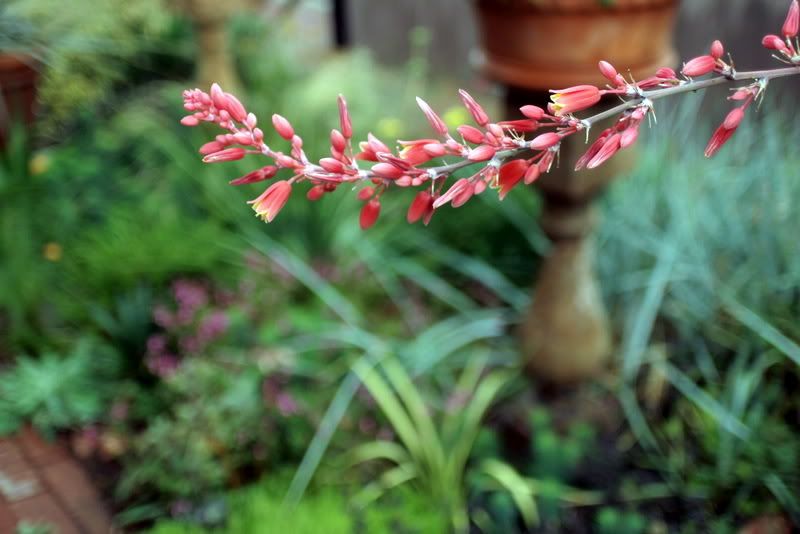
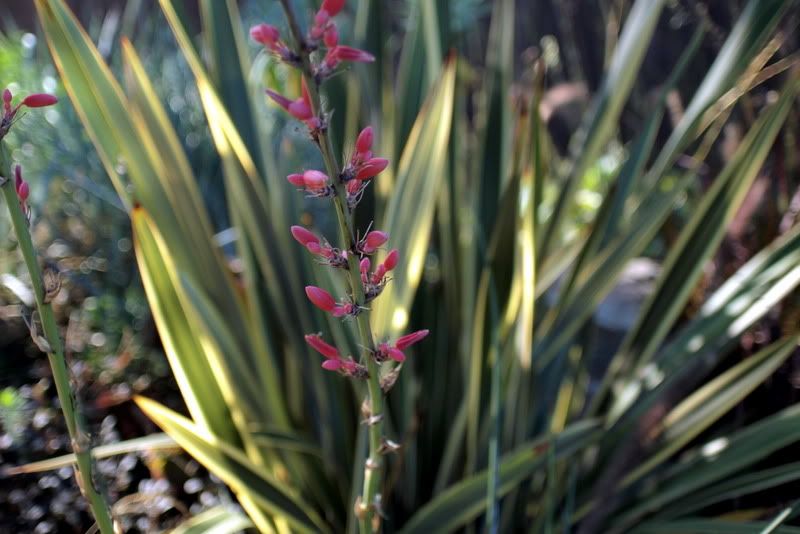
The red yucca, Hesperaloe parviflora, has such long-lasting blooms, you’d think I’d occasionally get a photo of them.

Photobucket

Photobucket

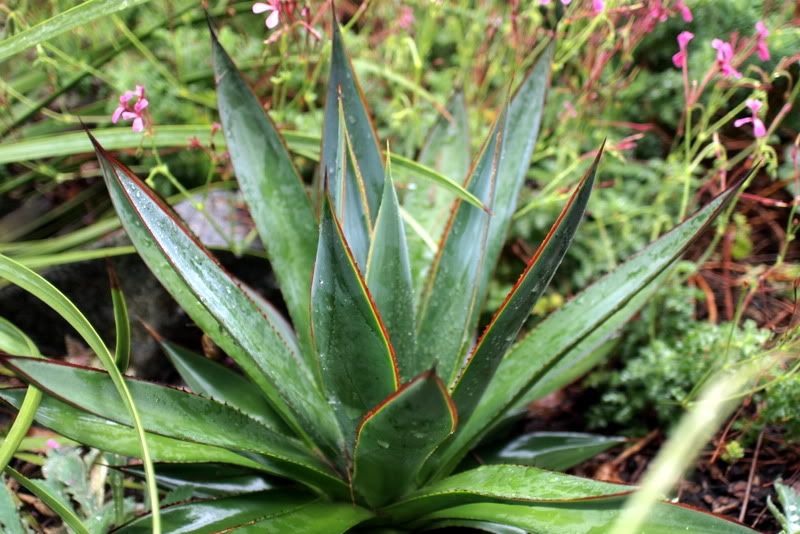
Weeding the poppies, I noticed that agave Mr. Ripple is offsetting, throwing some pups quite a distance away from the mother plant. That’s a little scary.

This little agave, ‘Blue Glow,’ is much better behaved.

Photobucket

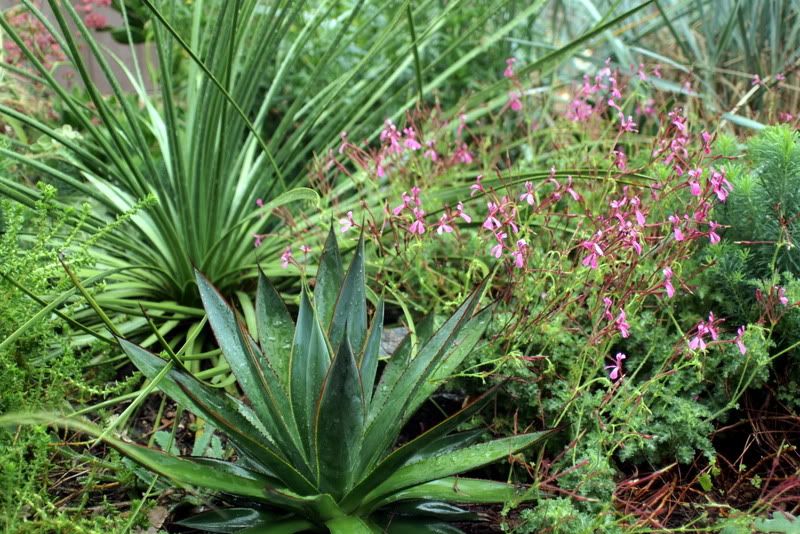
From further back, with the little Pelargoniun ionidflorum to the right, a very tough customer. The burgundy-flowered Pelargonium sidoides also thrives here in almost xeric conditions.

Photobucket

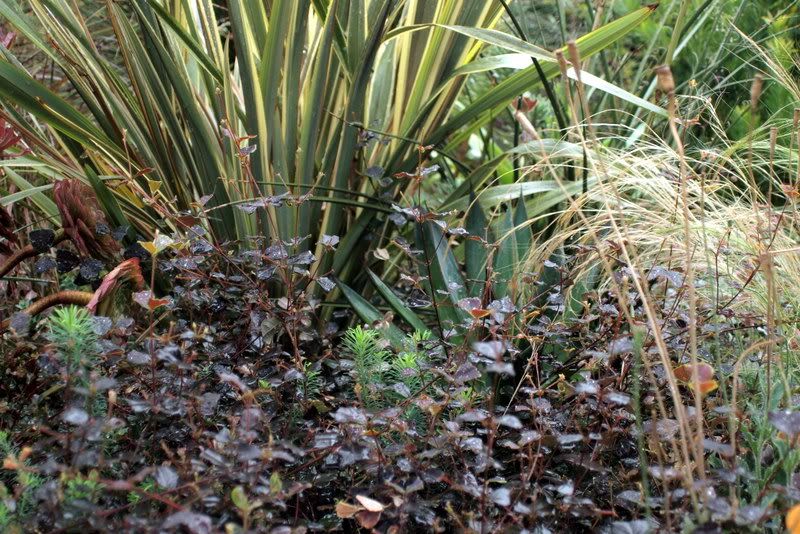
Another ‘Blue Glow’ agave tucked in close to phormiums and the Brachysema praemorsum ‘Bronze Butterfly,’ the nasella grass, and poppy seedpods, of course. A little more thinning might be in order.

Photobucket

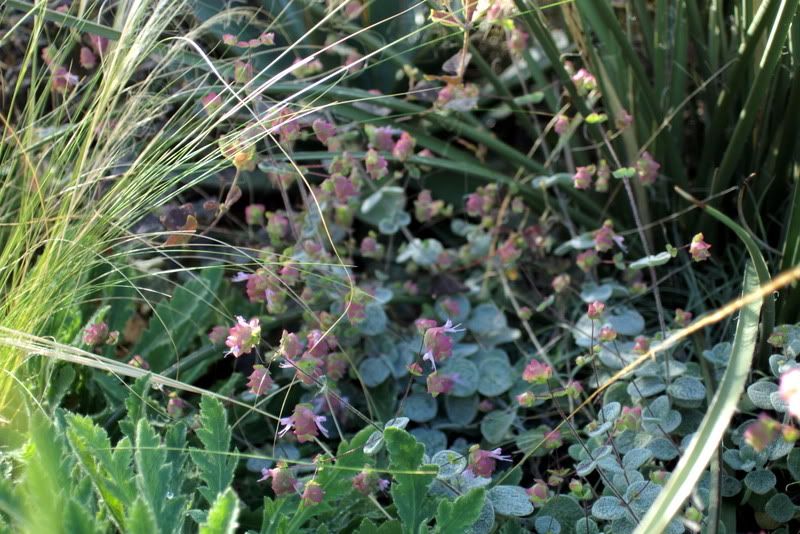
Ornamental oreganos flourish in the bone-dry conditions.

Photobucket

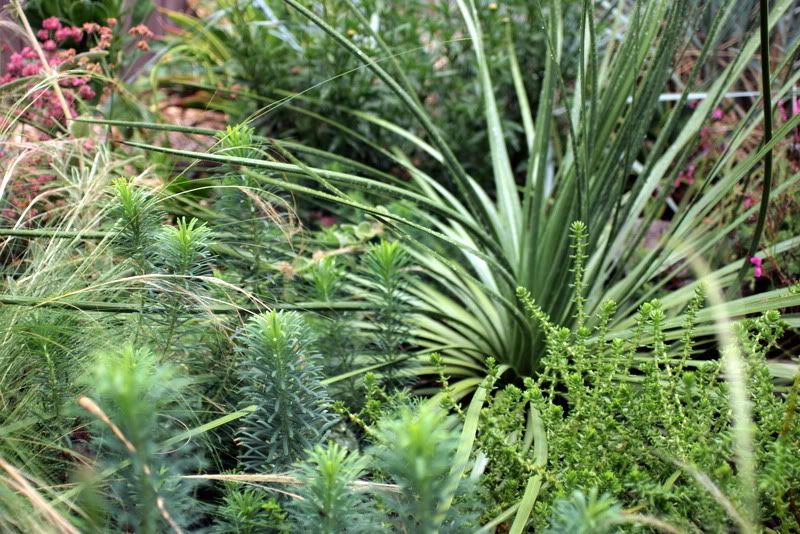
Even though every plant in this photo is green, what different texture each brings to the garden. The Euphorbia nicaeensis, on the left, has gotten a little too happy here.

Photobucket

Posted in agaves, woody lilies | Tagged , , , , , , | 6 Comments

Samphire

You’d think selecting plants based on leaves, flowers, bark, and berries would be more than enough criteria to consider, but occasionally the quest for plants takes in other, less tangible considerations, at least for me, and certain plants can edge out others in desirability for reasons other than their good looks.

Take samphire. Isn’t that the most gorgeous word? The hard “m” to bite into, unlike “sapphire,” which spills (or luffs, for sailors) all that air.


Photobucket


Continue reading

Posted in Plant Portraits | Tagged , , , | 5 Comments

Weather Report

A couple days of over 90-degree heat woke the tropicals up.

Tibouchina heteromalla

Photobucket

Photobucket

But we’re back to overcast skies and drizzle, lovely for late July.

Photobucket

In the Tom Waits-inspired, emotional weather report category, we’ve been frantic about a baby mockingbird, who either jumped or fell out of his nest this morning. Evie the cat had him cornered, but the parents were unrelenting in their defense and drove Evie away. We picked up the little guy in a file folder, transferred him to an empty straw basket, and put the basket back in the fringe tree, just below the original nest. Just a few minutes ago, a mocker fed him a worm in the faux nest. What a relief! And all cats are house-bound for the next couple days while flight training proceeds.

Posted in Plant Portraits | Tagged | 2 Comments

Foliage Followup

The book-end to Bloom Day, the 15th of every month, is when leaves get their due, Foliage Followup, the brainchild of Pam at Digging, who’s been regaling us in words and photos with an account of the recent blogger mash-up in Buffalo, New York.

One of the mossed orbs on a 5-foot stand. Snails rarely climb this high, or I find them in the morning when they’ve just arrived at their destination and are too exhausted to eat.
Not too sure if snails really ever exhaust themselves, but for whatever reason, these succulents go unmolested.

The variegated succulent in the upper left is an impostor, not a succulent at all, but a chunky-leaved plectranthus, Cuban oregano, growing compact and lean on a succulent diet.

Photobucket

Posted in succulents | Tagged | 8 Comments

Sybarites Unite!

The cats have completely taken over the biv, as they do all the choice sitting spots.

Photobucket

Work schedule causes summer to hurtle along into fall. I know, I’m grateful in such perilous times to have the work. But amidst this unjust state of affairs, where there are those who work too much, some can’t find enough, some find none at all, it occurs to me that gardeners are the true sybarites of the world. Who enjoys the world more than us? (Well, forget about cats for a moment.) We don’t defer enjoyment, as in having to drive to the perfect rock-climbing or fishing or surfing spot. We simply step outside the door, and enjoyment floods in.

Photobucket

To chain a sybarite to a desk in summer is a crime analagous to slipping amphetamines into the morning kitty kibble, in a reversal sort of way.

Photobucket

Someone once gave this mostly Irish family a sign: “Authentic Irishman for Hire.”

Perhaps there’s one hanging in your garage too.

Photobucket

Sybarites can do all of the above and more. We just need a bit more self-promotion:

Authentic Sybarite For Hire (Summer)
Botanizing and pontificating
Gardening, skylarking, and carrying on.
Available all hours.
Experienced digging companion.

Sybarites unite!

Posted in Ephemera | 3 Comments

July 2010 Bloom Day

I’m late, I’m late…

Photobucket

for a very important date…(yeah, right. It’s called a job.)

Photobucket

No time to say hello/goodbye, I’m late, I’m late, I’m late!

Photobucket

Now scurry over to our host’s site “May Dreams Gardens, for a perusal of Carol’s and other bloggers’ garden blooms for July 2010.

And take your time.

Posted in Bloom Day, Plant Portraits | Tagged | 4 Comments

Plants, Get Thee Behind Me

Just wanted a quick outing, a bit of plant gawking after a week of far too much sitting.

But the flesh, as usual, was weak. Too many mid-summer temptations at the nursery.

Photobucket

The eggplant-colored beauty is Pseuderanthemum ‘Black Varnish.’ I ordered this from Kartuz Greenhouses last fall, very poor timing to bring this heat lover on board even in Zone 10, and it slipped away over the winter. I think these “repurchases” go in an entirely separate category of commerce, more akin to honoring a commitment, even if repeatedly at full price. The ‘Mojito’ colocasia was a good bargain in a gallon. Nuff said there.

The firecracker plant, Russelia equisitiformis ‘Yellow,’ is new to me, and I’m completely smitten with its spilling, horsetailish ways and tiny, pale yellow, phygelius-like blooms. Hopefully, a better photo soon, this one being purely illustrative of its growth habit. Morning sun and afternoon shade will suit all three newcomers.

Photobucket

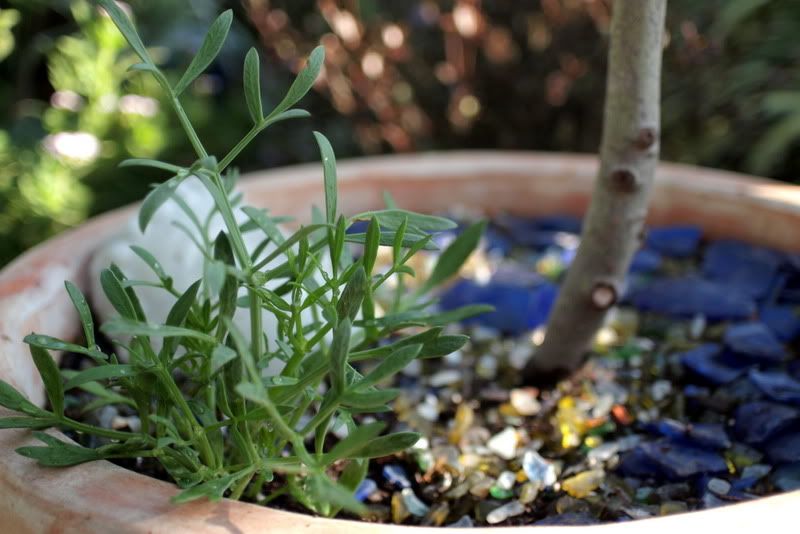
An overgrown Helichrysum petiolare was pulled out of the large pot it shared with a little manihot tree, whose trunk is visible in the above photos. Kept the manihot, improved the soil, and added the new tropicals. Typical of manihots, its leaves are several feet out of frame, sprouting at the very top of its 5-foot trunk.

Photobucket

At the nursery, something strange happened as I walked briskly past the tables full of summer annuals.

Photobucket

Meet Petunias ‘Phantom’ and ‘Pinstripe.’ So incredibly velvety. Now, I’m definitely not a plant snob, but I just haven’t felt the need to bring a petunia home in, oh, 20 years or so. Chalk it up to mid-summer plant madness, or maybe I was mesmerized by that Joker pinwheel, unhinged by the splashy colocasia, or just plain succumbed to how smashing all these plants looked together in the nursery basket. But I think these oddities deserve — no, require — a pot to themselves. Perhaps in an out-of-the way corner.

Posted in The Hortorialist | Tagged , | 9 Comments

Cutting Back the Agave Walk

As I’ve written before, this little walkway is often under siege by sprawlers (or gloriously festooned with plant life, depending on your point of view).
When half the path disappears under plants, even I know it’s time to do some cutting back. Agave geminiflora stands tall in a pot, safe from being inundated.
After the mid-summer cutback, the agaves remind me of stranded starfish once the plants recede.

Photobucket

The ‘Waverly’ salvia was cut back by at least half. Still plenty of salvia left for the hummers though. This will probably be the salvia’s last year in this spot, since it’s grown excessively woody and needs to be started again from cuttings. The two large pebble pavers were completely buried by it.

Photobucket

I long ago read that the ‘Waverly’ salvia was a spontaneous hybrid of S. leucantha and S. chiapensis. I repeated this on a forum, and Richard Dufresne, salvia expert extraordinaire, queried where I had heard this. Of course, I had no memory of where I’d heard this, and it was purely unsupported, anecdotal information. Sometimes being an amateur vs. an expert has its perks. You get to shrug instead of sweat the details.

Interesting about plant nomenclature. It’s usually no more than a nuisance keeping up with changing names, but occasionally it does impact even the home gardener. A few years back I thought I’d try the dwarf Salvia leucantha, the variety ‘Santa Barbara,’ and ordered it from the wonderful Northern California nursery Digging Dog. They sent the ‘Waverly’ salvia, which I hadn’t grown in years due to the massive size it reaches. I was amazed that this estimable nursery made such an error, but soon after realized it was a result of their being up-to-the-minute on nomenclature, a problem of too much information. They immediately straightened out the order. As the San Marcos link indicates, two salvias were simultaneously known at that moment in time as Salvia ‘Santa Barbara,’ the dwarf leucantha and this salvia I’ve always known as ‘Waverly.’ The ‘Waverly’ in my garden are descendants from that mishap. And the true identity of the ‘Waverly’ salvia still remains a mystery. Growing the mystery salvia formerly known as ‘Waverly’ at the edge of a border rather than mid-border nicely handles its size and sprawl issues. Much better it sprawls on bricks than neighboring plants.

Leaving the thorny thickets of botanical nomenclature and back to the now wide expanses of the agave walk, relatively speaking. Trachelium caeruleum has seeded into the dry-laid bricks.

Photobucket

Caladrinia spectabilis still waving long wands of magenta poppies. Long may it wave.

Photobucket

Back near the potted Agave parryi, Cobaea scandens leans a bloom on Ballota acetabulosa, which is also in bloom, though almost imperceptibly.

Photobucket

See the little bobbles? Another first-rate sprawler but one of my favorite plants.

Photobucket

Posted in agaves, woody lilies | Tagged , , , | 7 Comments

Bivouaced With Gardens Illustrated

Or up in the “biv,” as we call it. I’ve never outgrown a desire for spending time in out-of-the-way spots, preferably off the ground. I spent considerable time in trees and on the roof as a kid.

This particular bivouac is just the 4×10 roof of the little outdoor washer and dryer shed built against the house, southern exposure, garden side. The roof of the laundry shed was turned into a little deck/fort built for the kids but hasn’t had much use in years. Only roughly six feet off the ground and can support quite a bit of weight. Like a bench, your back is up against the house. A ladder is propped up against the shed for access to the deck. When the kids used it, we built a railing for safety but recently removed the termite-chewed remnants of it.

To become bivouaced, one grabs a stack of neglected reading material, books, magazines. Snacks are optional (I brought some pistachios.) Climb up, and you’re now righteously bivouaced for a holiday afternoon, waiting to ride bikes to see some fireworks when it grows dark. It’s an entirely new perspective up here.

Photobucket

On the way to the farmer’s market this morning, I happened to spot some marine-grade, canvas-covered chaise lounge cushions being discarded that would be perfect for the biv.

Full disclosure: In truth, I asked to be let out of the car because the most beautiful Agave desmettiana I had ever seen was planted in the front yard of a house of this little beach community we were driving through called Naples. Dark green with slim yellow striping on the leaves. Maybe there was a pup just hanging off of it. On close inspection, there wasn’t. The agave was perfect, no pups easily seen, and I would never take a chance in possibly desecrating such a beautiful agave, at least without knocking first. All your plants are safe with me, no worries. Walking back to the car is when I found the cushions in the alley. The broken plastic chaise lounges I had no need for. These are the cushions now in the bivouac, first loosely covered with a beige canvas painter’s tarp, one of the largest, most useful lengths of finished, durable fabric to be had for about $5 at a hardware store — its various guises include table cloth, picnic blanket, small tent, impromptu overhead awning, cushion covers, etc.

Back to the biv. At first, it’s very difficult to concentrate. The canopies of the trees sway just a few feet away, birds cut through an air space that we both now share. Butterflies waft in and out. After a good bit of skylarking and settling in, it was back to the business of catching up on some reading. There’s an article in the Atlantic I’ve been waiting to get to, but who am I kidding. The entire afternoon is given up to rapturous perusal of the June Gardens Illustrated. No magazine does plant talk like GI. I eventually called out for paper and pencil and was handed up a notebook and pen.

Plants of desire:

Akebia longeracemosa; from Taiwan, less vigorous than A. quinata. This image I found on a German academic website lacks the sheer porn value of the GI image but gives a fairly good likeness, except that the racemes just aren’t all that long in this photo. In GI the racemes dripped like wisteria.

Photobucket

Peucedanum verticillare, an umbellifer I’d never heard of. Like bees, I can’t get enough of umbellifers. Photo from The Guardian:

Photobucket

Cavolo nero, the Italian black kale I’ve been reading so much about. Perfect for fall planting. Photo from the Wine Berserkers website.

Photobucket

Papaver atlanticum, said to be “prettier” than the Spanish poppies that have colonized the gravel garden, P. rupifragum.

Epilobium, the fireweed, or rosebay willowherb, is now called Chamerion. I had no idea the name changed. GI always pushes the white version, and it’s utterly impossible to locate, at least in the U.S.

Ageratina aetissima ‘Chocolate.’ This plant looks awfully familiar, but that name — oh, yes, Google identifies it as formerly known as Eupatorium rugosum. Again, no idea the name changed.

Isn’t it interesting that about the same time people were taking down walls for open floor plans indoors, garden rooms outdoors became the rage. Every article must use the phrase “distinctive garden rooms” at least once, as though it’s a new and novel practice. I’m not against planning a garden in rooms, but it hardly seems distinctive anymore.

I loved Carol Klein’s quote about a changing garden: “Appreciating a planting scheme is more like watching a film than looking at a picture.” But exactly, Carol.

Wonderful portrait of Piet Oudolf’s wife, Anja Oudolf, married to Piet at 21, and runs the nursery.

Another good piece on the designer Raymond Jungles, who counts as major influences Luis Barragan and Roberto Burle Marx. A client of Jungles describes his style as “Nature almost wins.” And I’ve now added Brazil as garden trip destination to see Burle Marx’s estate.

Ending as usual with a great essay by Frank Ronan about seeking perfection in gardens: “A garden is a collaboration with nature, which was making perfect things before we were making things at all.”

And I skipped entirely the article on meconopsis.

Posted in Ephemera | Tagged | 8 Comments