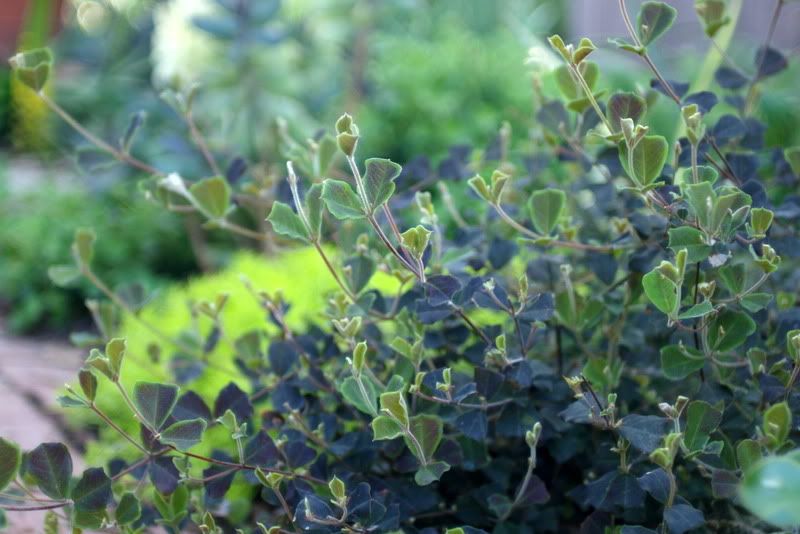
All I could remember about this beauty was the name ‘Bronze Butterfly’ and that he was a California native, but I was
only half right.
Brachysema praemorsum ‘Bronze Butterfly’ is from Australia. Takes the harsh conditions of the front gravel garden in stride,
which include minimal irrigation in summer but also low light levels in winter. The odd-shaped red flowers are superfluous,
to me anyway. Hummingbirds say otherwise. Low growing to 2 feet, lightly clipped to keep it about 2-3 feet wide.
I’ve only once seen it in commerce here in Southern California — the day I bought it, now some years ago.
Spring growth brings that tart chartreuse edge to the dark leaf. Beautiful shrubby texture for the agaves, phormiums
and sedums surrounding it.
This will be a hybrid post, a muddle of the two categories, by no means an exhaustive inventory of what’s in
bloom and leaf here, early spring in zone 10. There’s salvias, annual poppies, succulents throwing out the odd
flower, even a long-awaited bloom on a dyckia, but it seems to be less and less about flowers in my garden these days.
(Which hurts my stomach to type that.) What will happen to my former obsession with a symphony of flowers for spring
and summer? Has my obsession foundered on the shoals of middle age? Will my agastaches survive these El Nino winter
rainstorms? Such weighty matters are inappropriate considerations for Bloom Day, so off for a stroll among the flowers.
Well, that was a short stroll. Five feet out the back door and we find Orlaya grandiflora, Minoan Lace,
a charming umbellifer from Crete, who has been the devil to photograph. The intriguing fretwork of its flower
is more often than not buried in an undifferentiated white smudge of pixels. But I keep trying.
The flower bud is a slightly less difficult subject:
The orlayas will hopefully self-sow as happily as plants like haloragis and labrador violets. That is to say, those last two are the happy ones,
not me, with their fecundity — I’m so-so about the haloragis and absolutely in despair over the violets.
Another “happy” plant, Corydalis heterocarpa, garden thuggery disguised in an ornately compound leaf, has the most vile, sickly sweet,
retch-inducing smell when handled. No doubt a major factor in failures at eradication and its continued success in my garden.
The orlayas have been planted among ‘Blackbird’ euphorbias, all grown from cuttings last summer.
They are not yet the good-sized plants envisioned as boon companions for the wispier transient stuff but are still just a few inches high:
From Annie’s Annuals, the seed strain Giovanni’s Select of cineraria has reached 3 feet and is budding:
Magnolia liliiflora ‘Nigra,’ the Tulip Tree. I seem to be doing everything wrong with this magnolia — not enough water,
too much pruning needed due to poor siting — but still it thrives. For over 15 years, its big leathery leaves have screened and shaded
the west side of the house in summer, and for this it is forgiven the unsightly mildew (water stress?) it succumbs to without fail every year.
I doubt I’d plant him again. I’m normally not a sentimental gardener but make an exception in this case. The magnolia stays.
I seem to be on a roll with the trailing and tendrily crowd lately, and this little evergreen Australian vine is in bloom around the neighborhood so he definitely rates inclusion.
There’s two blurs of purple as I drive out of my neighborhood to work and errands, one on each of the north/south avenues that bookend my street.
This mailbox planting faces west. The effect is of a diminutive wisteria, a dainty variety that won’t tear the eaves from your house. Easily kept to under 10 feet.
It blooms early spring here in zone 10, which is apparently now. After bloom, cut back by as much as half to keep the scragglies at bay and for more uniform bloom, i.e.,
not all concentrated at the top of the vine.
It is close to violently violaceous, but growing the pink or white varieties would seem to be missing the point. Hardy to the low 20’s.
Also answers to Purple Coral Pea, Australian Lilac, False Sarsaparilla (I’d like to know the story behind that last one):
Yes, along with the fishhook senecio, there are quite a few that will spill and drape.
A couple I have on hand that I especially enjoy include this crassula, which can’t be beat
for a refined, airy, cumulusy presence and the rugged performance of a succulent.
Crassula sarmentosa:
Senecio jacobensii, Trailing Jade, is a slow-grower that turns this stunning shade of plum in winter:
(And in verifying the names, I’ve come across the identity of the mystery succulent which was the subject of the post “Excitement.”
Senecio medley-woodii. Of course! Yellow daisy flower was the tip-off.)
Just a friendly tickle from Cobaea scandens. Teucrium fruticans azureum has nothing whatsoever to worry about, nor does the solanum or ballota. Helleborus lividus can rest easy.
Cobaea: Rumors of my expansionism are greatly exaggerated. That’s allegedly 30 feet. That New Zealanders consider me a noxious weed only attests to their alarmist tendencies. Along with their
nuclear-free zone, they’d apparently like a cobaea-free zone as well. The nerve of those kiwis! My friends, who I count many in number, call me Mexican Ivy, Cathedral Bells, Monastery Bells,
Cup and Saucer Vine. I am beloved. Cathedral walls, chain link fence, makes no difference to me. I’ll cover them all!
Teucrium: Yes, of course you will. But, excuse me, can you shift to the left a bit? There, that’s it. Ah, that sun does feels good where you’ve been leaning in a bit heavily. Coming from the Mediterranean,
I am an avowed sun worshipper, you know, along with my pale friend ballota.
Ballota: I think we’re getting along beautifully!
Teucrium: As do I! I’m not blaming anyone. It’s just she’s done it again, sandwiching us in and leaving it to us to sort it out.
And, no offense, Cobaea, but I don’t think that 5-foot tripod is adequate to contain your…ahem…enthusiasm.
Cobaea: Nonsense! I certainly know how to behave. Why I take exception to…
Hellebore: Say! What part of the Mediterranean do you come from? Ever been to Corsica?
Solanum: (gasping) I can’t…breathe…
Cobaea: Oh, my sincere apologies. How’s that? Better?
Solanum: (weakly) Yes, much, thank you.
Cobaea: Okay, everyone. Cheese it! Here she comes with those clippers again.
Of a triangular, dark green, corrugated leaf, of a delicate, jewel-toned flower in cobalt blue, calyces of plummy purple.
You bring it home, where it sprawls, hides its flowers, sprawls some more, and starts numerous fights with its neighbors. So you cut it back, whereupon, in a sulk, it refuses to flower.
You begin to pretend indifference, to care for it less, and then ultimately to care not at all.
You say, S. semiatra doesn’t do well for me, and file it under “doesn’t do well,” a neutral category, essentially blameless for all concerned, and move on, hardly bruised by a fleeting encounter with this denizen of the Sierra Madre del Sur. And, really, what else can you expect from a plant that doesn’t even have a common name, a cherished folk name? Obviously, not many lived with it long enough to get chummy.
Decades roll by. By chance you see the closeup again of exquisite rugose leaf and two-toned flower. There’s a faint chorus of garden harpies in your head crying no! no! But there’s that closeup beckoning you, and the harpies are soon drowned out by your thumping heart and they recede, but not before first raising the alarm. So now you’re on the alert.
You bring it home. You watch this salvia warily, waiting for the “troubles” to begin at any moment. Ah, yes, that sprawl! Memories flood back of its wayward idiosyncrasies, the bitter disappointment. So many plants have passed through the garden in two decades that it now seems a promiscuous blur, one long horticultural bender. So many good plants tried and discarded, seemingly in a race. To and for what, who can say? And it’s impossible to avoid the conclusion that the garden has not necessarily been the better for the endless variety.
So this time you watch the little salvia calmly, knowing it is not a personal rebuke if a plant cannot fulfill its needs in your garden. But it’s possible you just didn’t watch closely enough before, always in a rush, thinking there would be yet more and more plants to discover, to fail with. Decades later, you know this isn’t so, that the quest is finite.
And somehow, strangely enough, the quest has now changed from finding the next jewel to understanding the needs of those few with the best chance of flourishing in your garden. It’s very clear now you won’t be able to find all the jewels, only a very few, and if you keep rushing along you might miss those willing to grow for you if you’d just watch quietly and wait.
So you wish to sprawl, do you? Well, why don’t I plant you close to the pathway, where your wild ways will bother no one. But you’re getting in such a tangle now, and I do so want to see your flowers. Let’s prop you up on this wrought iron plant stand, shall we? It’s never been of much use elsewhere. Why, how clever of you to drape so fetchingly!
Hello, little friend. What shall I call you? Ah, ‘El Perdido,’ the Lost One (almost).
Some backstory, which begins improbably enough with tulips. The two plants would seem to have nothing whatsoever in common,
but that’s the joy of backyard Frankensteinian horticultural experiments, where you’re mad scientist in chief. And if you get up early
enough, there’ll be no witnesses, one of the best incentives for rising early next to strong black coffee.
Fishhook senecio, S. radicans, is commonly used to dramatically spill out of succulent container plantings,
like this one I made in a hay trough a few years ago:
It grows so fast, at the speed of knots, spilling and draping, puddling and pooling, that I’ve come to grow it less and less.
A couple pots are kept, shoved into unloved spaces now. Its vigor has caused it to lose favor with me,
but I keep it because it oozes potential.
Now the tulips. In zone 10, where mid-winter skiers drive an hour outside of Los Angeles to zip downhill in artificial snow,
tulips also need some fakery. The cold they need to bloom won’t be supplied by outdoor temps, so they are placed in
the vegetable bin of a refrigerator after purchase in fall, then potted up in late November, a necessary span of at least
six weeks for good results. Bad results look like the tulips are hunkered down in response to an air raid siren, just peeking over
the tops of leaves, never achieving any stem length at all.
Dark purple and apricot blend tulips were planted in these urns, but there were leftover bulbs, planted in hideous black plastic gallon pots:
With the backstory handled, now we’re regaining some momentum to this tale.
The tulips have been moved into the sun, buds are forming, stems
elongating. So far, so good. But there’s still those hideous black pots.
I assumed the black pots of tulips in bloom would be cleverly hidden in the garden amidst
blowsy spring annuals, but growth in the garden is not tall enough yet for such
chicanery, and the tulips are rapidly rushing into flower. A large pot is now what’s
needed to serve as a cache pot, and there happens to be just such a pot standing idly by.
So one large pot, unscrubbed (you can scrub yours…)
with another pot nested inside for a platform for the tulip pots to
stand on. Expect lots of rummaging through old pots to make this work.
Once the platform of nested pots is adjusted, on go the tulip pots.
Now it’s apparent the whole arrangement is simply more of the same hideous because
the black pots cannot be concealed short of stuffing the spaces with
moss, a technique best reserved for the sterility of business office foyers (and I
don’t have any moss, darn it).
A filler is needed, but what?
It is at just such a moment that the gardener methodically walks the length and breadth of her
garden, taking new inventory of the familiar with laser-like focus, possibly muttering softly to
herself. A plectranthus is temporarily considered but rejected for not enough leaf.
Mid-winter there’s absolutely nothing that will do — but wait, what about the fishhook?
That’s the answer!
The pot is grabbed from its neglected status on a side porch flanking the driveway
and carried into the back garden, 5 feet of trailing fishhook bringing up the rear.
Some careful maneuvering onto a couple bricks for the new platform, some wrapping and weaving,
and the black plastic pots are hidden.
And after that buildup, I know the next photo might seem a tad anti-climactic:
Possibly slightly better than hideous. But I was newly struck by the amazing potential of
S. radicans. With so much interest in plant material for roofing and even siding of green buildings,
for zone 10 I submit the fishhook senecio for consideration. Because it is pliable and will root at leaf nodes,
the possibilities seem endless. I’ll probably take this experiment with tulips apart, but what about
wrapping a moss orb round and round, where it can root and trail at will? Or “curtains” of fishhook
senecio for a faux window on a fence? No doubt more early morning experiments are ahead this summer.
Him: (standing on porch, looking blankly at radically transformed garden)
Just tell me.
Me: You’re kidding, right? Can’t you tell?
Him: (squints, nervously shifts weight from one foot to the other.)
Me: Well, for starters, that 8-foot alien gomphrena is gone, since the rain flattened it anyway.
And that table has been moved. This other table with all the crap has
been cleared out. All the small pots are gone, leaving just a couple essential large ones. The grape vine has been cut back and the iron trellis removed.
Isn’t it more open now, less hectic?
Him: Uh-huh, oh, yeah.
Me: I thought leaving this big table with nothing on it would be a nice touch,
kind of a departure for me, you know, where we can sit and eat and
everything, like al fresco Americans. Everything’s much simpler.
Ever since I found a souvenir of a lost rose while digging last fall, I’ve intended to tease out my complex relationship with roses (aka blog about it.) The souvenir was the crumpled, muddied tag of the tea rose ‘Souvenir Pierre de Notting.’ Unearthing the faded remains of a once flourishing plant, I was stricken by the uncountable sums of roses that have passed through my garden.
There was the beautiful 20-foot monster ‘Cerise Bouquet,’ armed to the teeth, that I cut back and dug up after a year of increasingly nervous observation in my own garden, then inflicted on an unsuspecting neighbor: “Here’s a pretty rose I don’t have room for. Gotta go!“
There were the Austin roses, named for Shakespearean characters (Othello) and English industrialists (Abraham Darby) and characters from Hardy (Jude the Obscure), promising the scent and form of old roses but with repeat bloom and disease resistance. (I will vouch for the scent and some repeat bloom.)
There was an extended fling with the hybrid musks, a very fine, long-limbed class of roses. A prolonged and deep infatuation with the tea roses, a class dating back to the 1800s, arguably the best for zone 10, where the cabbagy centifolias and purply gallicas refuse to grow because the summer party lasts too long here, and they don’t get their needed winter rest. A stray Bourbon occasionally wandered into the garden, and once or twice a hybrid perpetual, the latter bringing new meaning to “finicky.”
Enthusiasts will always assert that wrong choices are at the back of every burnt-out rose grower, that they just haven’t found the right rose yet.
Not so, says, Tom Fischer, who in late January guest-ranted on Garden Rant, making no secret of his disdain for roses, inciting the equivalent of a five-car pile-up on Gardenrant, a happenstance usually reserved for searing discussions concerning lawns and whether or not to remove them. Mr. Fischer made it clear he just didn’t plain like the looks of them.
The subject of roses, whether to include or banish them from gardens, is a topic that can arouse vociferous debate among gardeners. I can think of no other plant as controversial, and it is a testimony to their hold over our imagination that we feel compelled to trumpet our allegiance or publicly admit defection from the cause of the queen of flowers.
Garden designer Michelle Derviss wrote in her blog Garden Porn just a couple days after the Garden Rant post of the travails of professionally maintaining a formal rose garden in Northern California. No love lost there either.
Here in Southern California, roses aren’t the malingers and valetudinarians so often complained of in colder or more humid zones. Here they are robust, long-blooming. In fact, they are downright ubiquitous. They may rust or mildew, but there are no Japanese beetles to contend with. That sawfly larvae will chew blistery-looking holes in the leaves is a given, but I’ve never had the dreaded “black spot.” Other than the climber Chromatella that I lost to crown gall, most roses are expelled from my garden in a fit of irritability, a violent expulsion that more often than not occurs sometime between November and February. The delicate tracery of the leafless branches of a deciduous tree against winter sky is a welcome sight. A rose in anything but full bloom and leaf is, conversely, just not worth looking at.
I’ve never been one to shy from ruinously time-consuming garden tasks. Even pruning has its zen moments. For me, the unhappiness started when I began to pretend I could have a garden with roses and lots of other plants too. Mine would not be a “rose garden” per se, but a generalist’s garden, also filled with small trees and shrubs, grasses and succulents. This was wishful, magical thinking, a mode of thought gardeners excel at, and the queen soon put her foot down and demanded an oath of loyalty to her and her alone.
The eye is riveted on a rose in a garden, whether in or out of bloom. (Especially out of bloom.) The rose ultimately decides what else can be grown alongside it. The rose must have the sun. The rose must have the best soil and the most water. The rose is a lovely but insatiable vortex of neediness.
It took a long time to admit I was fed up. Why so long?
Because waiting for roses to bloom is exciting. Because Shakespeare likes them too. Because they smell nice. Because they’re sexy (sometimes sluttily so). Because roses photograph beautifully.
Because England and France agreed to a temporary truce during the Napoleonic Wars so Napoleon’s Empress Josephine could secure safe passage for the roses she was acquiring for her vast collection at Malmaison, where the Belgian painter Pierre-Joseph Redoute would immortalize them.
That bit about Empress Josephine, that’s what gets you hooked. There is a sumptuous history behind every name. There are the heroic hybridizers, such as John Champneys, who created the first noissette in the Deep South, sending it back to France for breed stock, thus producing one of the most beautiful classes of roses imaginable, the noisettes and tea-noisettes, from which stock was born my achingly lovely ‘Desprez a Fleur Jaune,’ seen here in her prime.
I cannot pretend to be impervious to their charms. Roses in bloom confer a dreamy romance on a garden. I think what I finally objected to was their lack of egalitarian spirit. Their insistence, noblesse oblige, that every other plant in the garden be their handmaiden and not their equal. In shades of scarlet conquering, the rose must have everything.
It’s possible I’m trying to talk myself out of love here, very possible. Water restrictions are a reality, and though roses are tough, they are not drought tolerant. Their history and provenance will always be a rip-roaring good read, but except for two (‘Bouquet d’Or’ below and ‘Crepuscule’), for now the garden is exiling all royalty to the other side of the gate. Viva la revolucion!
(But can I come and admire your roses when they’re in bloom, please?)