Sunshine Conebush

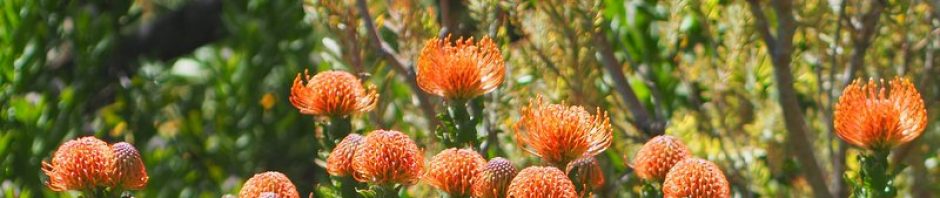
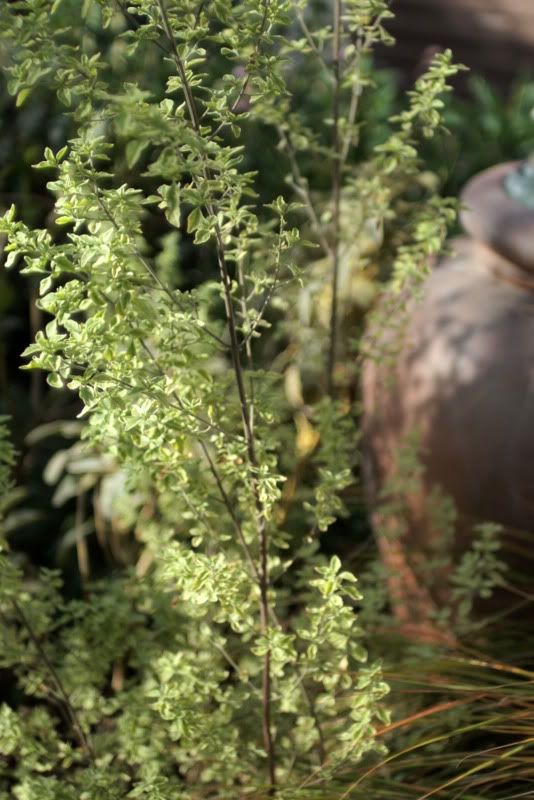
A U-turn-worthy sight driving in the rain to a job in El Segundo (Southern California zone 10). I’m guessing this is Leucadendron coniferum, the Sunshine Conebush, from the Proteaceae family. Someone clever had it backed by a deep russet-colored stucco wall.

Photobucket

Photobucket

The only word for it is…proteaceaelicious, no?

Posted in Plant Portraits, The Hortorialist | Leave a comment

Call Me Mr. Agave

(Also answers to “Big Blue”)
Photobucket

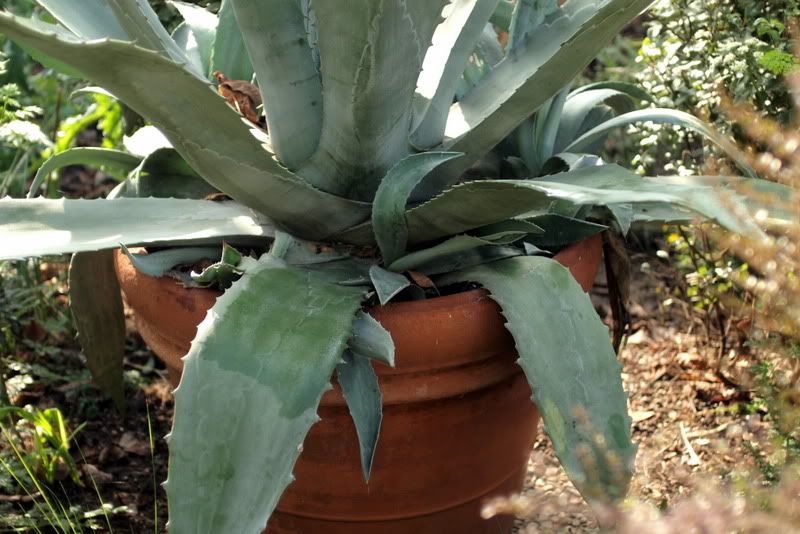
Note the congestion of pups destroying his fine lines. The vigor of an Agave americana is an awesome thing to behold and has been known to rupture any pot that dares contain it. Said vigor is the principal reason why he’s not planted in the ground, where he’d grow far too large. This one had already had a thorough de-pupping session in the last year, not long after he was brought home, a cast-off from a landscaping project at a local museum. Brutal as it sounds, A. americana is the trash species of agaves, at least here in zone 10. There’s loads of small, slow-growing agaves to choose from. The day I brought him home he portended instability for the garden, and I knew it.

Mr. Agave needed sorting out.

Essentials:
Photobucket

This level of foolhardiness has its origins in the mid-winter fidgets: No digging, no heavy garden work for three months and, consequently, I’m looking for trouble. Whoever said gardening was some genteel endeavor performed with an English trug on one’s arm and straw hat rakishly atop one’s head has someone else doing the heavy work. I live for the heavy work and miss it terribly in winter.

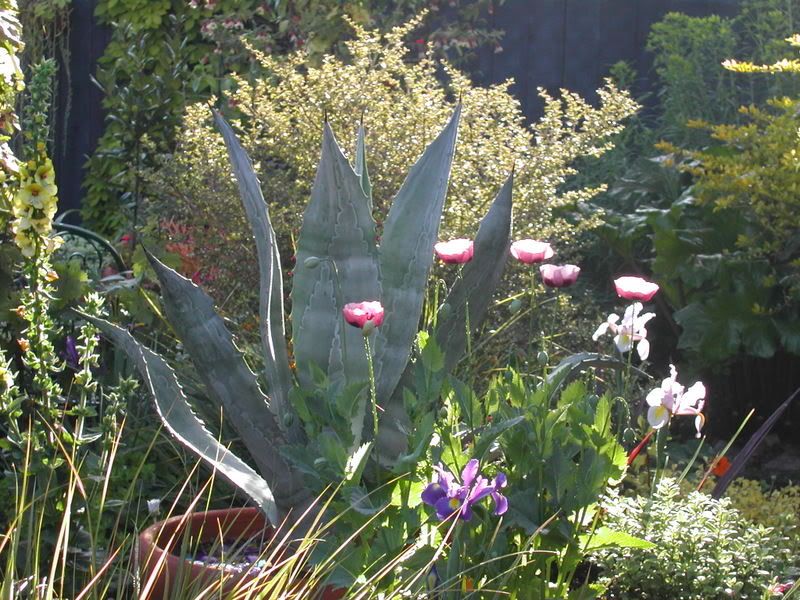
Mr. Agave is the centerpiece of the main back garden bed. Getting him in position in the first place was a long, hard slog. But once in place, all was forgiven as he seamlessly assumed his role in the garden, holding court, regal and impassive, from the first Dutch iris and self-sown poppies to the last dahlias.
Photobucket

Unseen in the photo, looking out from under the pergola, Mr. Agave is flanked on four sides by evergreen shrubs: two Kohuhu Golfball pittosporums to the south and two Coprosma repens ‘Cappuccino’ opposite, at the patio’s edge. It’s a barely perceptible nod to formality, especially in summer, but during winter this slight gesture adds welcome structural heft.

Training the Golfball pitts into the desired rotund shape was increasingly hampered by Big Blue’s rapid growth. Removing the pathway round the south side didn’t help. Where the Kohuhus once edged the pathway, now they’re adrift mid-meadow, so to speak, after the brick path was removed.

Short version is, access is increasingly difficult for garden tasks, a consequence of the unreasonable demands for more planting space I inflict on such a small garden. And as we all know, you just don’t tread on soil, especially clay soil. Ever. With the path gone, there was no easy access to the center of the garden border. The self-sown plants and grasses I wanted needed more room, and the access problem would sort itself out somehow…

The coprosmas were also problematic. Planted at the patio’s edge, they were growing tall and obscuring the view behind. Tall, sheer, and windswept was the original goal, which they were fulfilling, but I confess the day I read of the loathing Val Easton felt for them in her blog Plant Talk, their days were numbered.
Photobucket

For a good long while, I resisted her opinion. I love brown plants. I tried some judicious pruning. But I ultimately had to admit their brown leaf was dull, with no red tints or glimmer, and their shape was appearing more wayward and rangy by the day. Out they would have to go too.

And fickle, plant-lust driven creature that I am, I just happened to have two ‘Red Dragon’ lophomyrtus waiting in the wings, chafing in their pots, and here was a dark-leaved plant I could heartily defend. Slow-growing, lots of complexity to the brown coloring, clippable or not. A done deal.

In a few weeks, there’d be too much spring growth to contemplate moving the beast, so the time to act was now.

Or the kraken, as he increasingly appeared to me to be 30 minutes into the move, the sea monster/thorn in Perseus’ side and now piercing mine.

I’m still not quite sure how it was all done. The coprosmas were sadly easy to dispatch. It’s always a shock how easy it all is to undo. Once the coprosmas were gone, there was an opening maybe 2 to 3 feet wide to slide the potted agave from mid bed to the bricked pergola. At some point, there was a board for a ramp, then a tarp, then a towel-lasso thingy, but mostly lots of dragging, head bent down under his armored tentacles. Inches took a quarter of an hour. Blue glass mulch glittered a comet’s trail in his wake. I was gripped by numbing fatigue but also the stubborn refusal to have my garden upended. There would be resolution. The kraken would be either tamed or destroyed.

Photobucket

Madness! Folly! Why? Why? Whyeee? I was hoisted on the same petard as Werner Herzog’s feckless Fitzcarraldo dragging his steamship through the jungle.

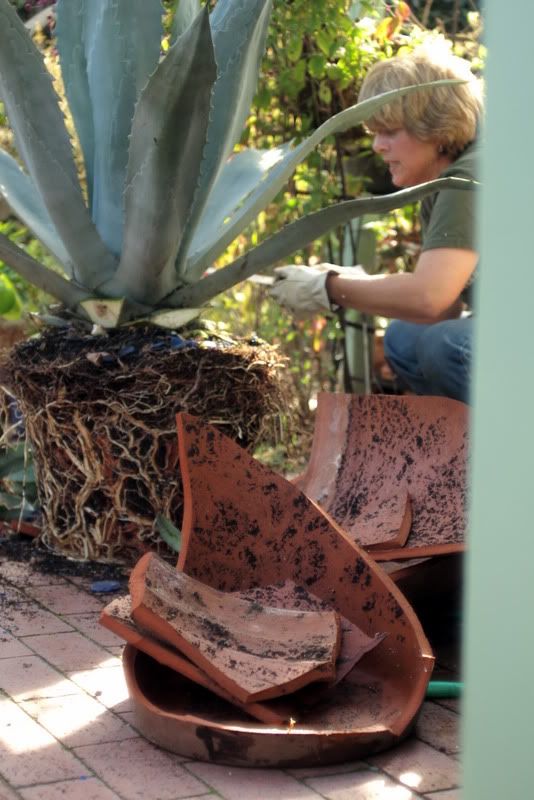
A chance recruit stumbled on this abysmal scene, took pity and pitched in, and with the extra pair of hands we moved him the last few feet to a temporary resting spot. Unimaginable relief. Let’s just tip him to remove the tarp — the pot leaned, gravity claimed its due, and the pot was on its side and smashed. And it really did seem like slow motion.
Photobucket

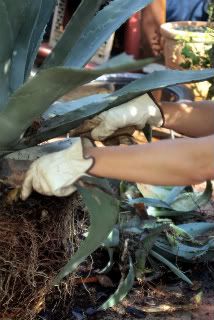
Still I cleaned him up, removed the pups, severely root-pruned him.
Photobucket

And then had no idea what to do next. There was no place to plant him — he’d be too large in six months. The pot was smashed and there was no other pot large enough. Work deadlines intervened, and he sat for a day in a muddy heap.
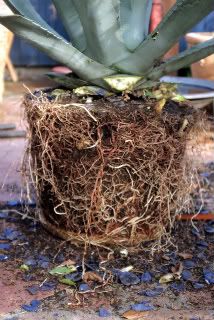
Photobucket

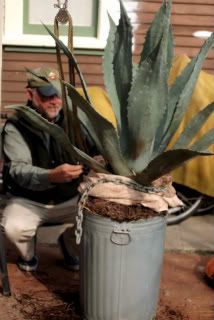
At some point, it occurred to me that the shiny silver trash can I keep potting soil in could be recruited for a pot. I dragged Mr. Agave to a possible site for him in his new trash can, but lifting him up and into the can was the first serious impasse with no clear solution.

I had a stray thought before falling asleep that night about possibly rigging some block and tackles. The next day, still in Fitzcarraldo mode, I jokingly mentioned it to my husband, sneakily testing his potential for being dragooned into an extremely hare-brained scheme. He never disappoints. Within minutes he emerged from the garage with, yes, a marine-quality block and tackle and a large chain. Lever, fulcrum, and with Archimedes’ blessing (“Give me a lever long enough and a fulcrum on which to place it, and I shall move the world”), we were back in action.
Photobucket

A happy ending was not to be. Even the trash can was no match for Big Blue’s girth, and he sits too high, no longer looking regal, just foolish. Maybe the coming rain will help settle him in. For now he’s just outside the office door, eye level instead of knee level, absurdly large for his surroundings. There’s talk of possibly more blocks and tackles and chains to swing him elsewhere. Just exactly where that might be is the open-ended question. Oh, for just 1/4 acre more of garden.

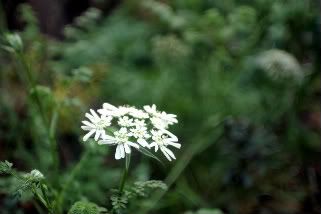
Callous as it seems, I can still manage to find the bright side to all this garden mayhem. Now that he’s been moved, it’s much easier to see the Orlaya grandiflora just coming into bloom.
Photobucket

Posted in agaves, woody lilies, essay | Tagged , | 1 Comment

Dragging Gen X & Y Into the Garden

Interview on Nest in Style with Duane Kelly, recent buyer of the Northwest Flower and Garden Show, wherein he gives a detailed answer providing possible theories as to why Gen X & Y don’t seem so hot to take on gardening, like their predecessors the boomers (these demographic epithets are so demoralizing to use, but nonetheless effective shorthand.)

Mr. Kelly feels that the horticulture industry hasn’t paid enough attention to marketing to X & Y.

Respectfully, I have a one-word answer: Houses.

Photobucket

Photo courtesy of Fullerton Heritage.

Boomers bought houses in record-setting numbers, facilitated by GI loans after WWII, and generally stayed put in them for decades.

Houses have space surrounding them that can be gardened.

Gen X coming of age during the Reagan and first Bush presidencies certainly saw some scorching real estate action, but how much was staying put and how much flipping houses for profit? Gen Y, aka the Millennial kids, I’d wager aren’t doing too well in the housing market.

No research, just a gut feeling. But what do I know?

Posted in essay | Leave a comment

Poor Man’s Jewels

Aeoniums and Helichrysum petiolare, very common in these parts. Matte and fuzzy riffing off each other, spangled in morning dew.

Photobucket

Photobucket

I’ve always felt plants more than hold their own in the world of precious objects. Lucky for my family, there’s really nothing else I’d rather gaze upon. My wedding ring is a plain gold band, and while I admire the craftsmanship of jewelers and silversmiths, it’s always been plants that rivet and hold my attention.

Photobucket

Helichrysum is routinely subsumed into summer container plantings, recruited for duty as the “trailer,” but it is so much more than a component in a formula for a summer container. It is an obliging plant. It is a clever plant. It is a supremely friendly plant. In the austerity and low light of a winter garden in So. Calif, its many fine qualities are burnished — doubly so without brash summer flowers elbowing it out of the limelight.

Photobucket

Which reminds me. I have seen a case of local benign neglect produce an amazingly innovative performance by the chartreuse variety of this helichrysum named ‘Limelight.’ What it has done is happily shrug off its mundane surroundings and wend its way up the wall, exploring the brick with its felt wands and arranging itself smugly in arabesques and curlicues. This stunning performance is there on the corner of 4th and I forget what other street for all with eyes to see. This gray one playing with the aeonium is a dwarf variety, so will not achieve that scale. They are perennial here in zone 10.

Photobucket

Posted in succulents | Leave a comment

The Trouble With Etsy

Yesterday morning, in the shower, I wondered if men were writing the code and starting up sites like Etsy, and if women were thereafter predominantly the ones selling their wares in this virtual bazaar. There’s no point to a lengthier prefatory explanation. One just never knows what ruminations a hot shower will bring about, though topics like what will 21st century labor look like are a good bet for me. Immediately after the shower, next order of business was Google.

My familiarity with the crafts site Etsy can’t be more than a year old, gleaned from reading design blogs probably. I’ve never bought anything from Etsy, but it is a very intriguing concept. One of my best friends in high school in the ’70s was an ardent practitioner of the the arcane needle arts, like lace making, tatting, and lots other esoteric ones that I don’t remember because, frankly, I just wasn’t paying attention. Chalk it up to callow youth, but I felt if it wasn’t Art, it was a hobby, busy work, a diversion and distraction from More Important Things. Throw in there, too, “women’s work.” I admired her handiwork and always offered enthusiastic praise and support, but was secretly puzzled by her zeal to pursue one craft after another as if her life depended on it. She serially tackled and mastered craft after craft, always producing exquisite work.

Sometime in the mid ’90s this friend took me to an exhibition in Santa Monica of Liza Lou’s “Kitchen,” and I began to see my friend’s obsession with new eyes. In fact, my friend had been one of the many volunteers who helped bead hundreds of blades of grass for “Backyard.” For Liza Lou, “The dignity of the doing is the meaning of my work.”

A detail of Liza Lou’s “Kitchen” from American Craft magazine:

Photobucket

I knew my friend hoped to ease out of her office job and sell her work at craft shows and maybe local shops, but she ended up landing a job with the U.S. Post Office which consumed even more of her time and energy, then had a child in her forties, and then — whoosh. I often wonder how things might have turned out if the Internet and Etsy were around back in the ’70s.

According to what my search string discovered, she would have allegedly entered a nearly all-female ghetto of craft piecework, a throwback to early 20th century sweatshops and disasters like the Triangle Sewing Factory Fire, albeit your own private sweat shop where the door remained unlocked in case of conflagration.

Someone had indeed crunched the numbers. First of all, my hunch was correct: The Etsy site is primarily used by women but was developed by some guys in Brooklyn.

The search string I used after my shower was “Etsy statistics male female,” which catapulted me into a controversy started by Sara Mosle in an article she wrote for Double XX entitled “Etsy.com Peddles a False Feminist Fantasy.” Sample quote: “Etsy actively fosters the delusion that any woman with pluck and ingenuity can earn a viable living without leaving her home.”

Mosle’s article was further discussed and its premise mostly rejected on The Frisky in an article by Amelia McDonnell-Parry entitled “Etsy: A ‘Female Ghetto’ For The Creative & Crafty?” Sample quote: “Etsy hasn’t pulled the wool over their eyes, they aren’t stuck in some artsy/crafty female ghetto just because they aren’t getting rich off handmade stationery.” The mostly irate readers’ comments are also worth perusing.

But wait, there’s more. The most incendiary rebuke to Mosle’s article comes from Jezebel in a piece entitled “Slate Ladyblog Slaps The “Feminist Fantasy” Of Etsy.” Here the readers’ remarks are, as my youngest son would put it, off the chain.

I remembered reading a more positive, boosterish piece on Etsy in the New York Times recently, so hunted for that. (“That Hobby Looks Like a Lot of Work,” by Alex Williams 12/16/09.) This article held out the hope of a possible six-figure income being derived from selling on Etsy. Here, too, the readers’ comments are as informative as the article itself. Reader “Lily Briscoe” (obviously a Virginia Woolf fan) wrote: “The products are creative and wonderful. I admire the women who produce these one of a kind items. However, from an economic perspective, Etsy is basically promoting a glorified version of piece work. In the early 20th century, women living in cold water tenements on the Lower Eastside churned out beautiful things too. The article reads like another sign that our country’s prosperity is sliding backwards. Where are the jobs that provide benefits and a living wage?”

Another reader warned that anyone knitting as many hours a day as a woman featured in the article would soon end up an upper-body cripple.

Brett from Arizona’s response to the NYT article: “Why did this home made market ever go away? Because mass production is cheaper and more efficient. That may sound like evil corporate speak, but it actually amounts to more resources being used. More gas for delivery, more on decentralized logistics and it all adds up to costing more to society than mass production. Mechanization and economies of scale made sense in 1900 and still do. Machines free us from drudgery and economies of scale make the marginal inputs into production less costly…as has already been told, some will find themselves returning to the servitude of manual labor that we purposely left behind during the industrial revolution.”

Etsy as business incubator or personal sweat shop? Another installment in the continuing saga of machines, fitness of purpose, people, work, labor, craft, what to do with our hands, what to do with our brains, what to do with our talents (how good am I at this skill anyway?), and as Liza Lou succinctly put it, “The dignity of the doing.”

Posted in essay | Tagged , , , , , , , , | Leave a comment

Winter Storms

The long-awaited winter storms did arrive with a vengeance, drumming rain deep into the soil. Don’t you want a subterranean view of a cross section of the earth moistening sequentially into ever richer chocolate layers as the rain percolates down in fudgy rivulets — how far down, who can say? (It’s both limiting and freeing, blessing and curse, to have an imagination unfettered by the laws of science.) The rains have brought worry and inconvenience to many, so a gardener’s elation is somewhat tempered by that knowledge — at least in polite company. Privately, this is a time for jubilation. The garden looks like it’s been slapped into taking a breath.

Leaving the land and heading out to sea, here’s the Los Angeles Lighthouse and jetty yesterday afternoon, clouds and wave spume nearly interchangeable. The photographer, MB Maher, is still seasick today.

Photobucket

Now off to satisfy an urge for a slice of chocolate cake, grab a cup of tea, and find the old dog-eared copy of To The Lighthouse, where Lily Briscoe paints in the garden and Mrs. Ramsay throws her shawl over an object in the children’s bedroom (an animal’s skull?) that keeps them awake and afraid. Fitting end to a rainy workweek.

More rain possibly next week.

Posted in MB Maher | Tagged , , , | 2 Comments

Cat on Pedestal

The pedestal being a stack of concrete that occasionally holds a pot or, as in this case, a cat named Newt, or is just left empty, a plinth crowded on four sides by the horticultural Darwinian struggle that is the front gravel garden.

Photobucket

The South African restio seemingly grazing Newt’s cheek behind the fountain grass is Thamnochortus insignis, which still holds the record for the most money ever paid by me for a plant. Now restios are available in 4-inch pots every spring/summer, but at the time, before even Hinkley’s Heronswood began to beat the drum for restios, it was a foliar revelation, a one-off specimen a nursery owned (and which set me back a c-note). It does amazingly well here in zone 10 with no real irrigation beyond the winter rains. In too much shade, restios can flop. But given the full sun and bone-dry conditions of the gravel garden, this one maintains it’s glorious upright vase shape year round. These photos were taken yesterday, on the afternoon of the 17th, just before the first (fingers crossed) of a supposed series of week-long rainstorms rolled in. The euphorbia obscuring Newt’s tail is E. lambii, the phormium ‘Alison Blackman.’

Detail of the restio’s inflorescence, arching and falling like Danny Ocean’s fountains at the Bellagio. Photo taken earlier in the year:

Photobucket

Back to the cat on the pedestal. Felis silvestris catus, our Newt, who can spit like a cobra, a performance we enjoy provoking until the poor thing gets cotton mouth. Newt has this amazing, sculptural sweep to her upper body due to, alas, the loss of a front limb from injury. “Spunky” seems like such a quaint, almost demeaning epithet, but it gets closest to describing this little cat’s resilience. And I suppose “spunky” fits the gravel garden as well. More on its plants later.

Photobucket

Posted in creatures, Plant Portraits | Leave a comment

Pelargonium echinatum

From Robin Parer’s Geraniaceae site comes possible confirmation as to the identity of my 3-year-old, winter-flowering, summer-dormant pelargonium, P. echinatum, whose winter performance in a 6-inch pot thrills me no end. Just as cold-climate gardeners haul their tender beauties out of mothballs every spring after danger of frost has passed, here in zone 10 the reverse process can occur in fall for summer dormant plants. About the time in November I’m tipping over the huge pot of the tropical Xanthosoma ‘Lime Zinger’ to keep it rain-free during the winter, growth appears on this charmer, signaling the need for moisture:


Photobucket

PlantzAfrica has extensive information on this species’ care and propagation. Possibilities are only limited by the number of pots containing ostensibly dead plants one has table space and tolerance for in summer, a time when one hopes their garden affirms life in its strongest voice. The danger is in tucking their unsightly dormant state too far out of sight and mind in summer, where the resurgence will go unnoticed in fall. Ensured success is as simple as tipping the pot right side up again to accept winter rains.

Posted in Plant Portraits | Tagged , , | Leave a comment

Foliage Followup (and other digressions)

The answer to Bloom Day, the 15th of every month, is the Foliage Follow-up, the brainchild of Pam Pennick of the excellent blog Digging, whose garden has endured both record high temps in summer and now record low temps this winter — kinda why “climate change” is more apt a term than “global warming,” since every cold spell is pounced upon as proof, aha! that carbon dioxide emissions are not causing warming (because then we’d be warm and sweaty all the time, right?) and that it’s all the socialist payback plot of evil scientists. But as reader Paul Schickler of Brooklyn so ably stated in a letter to the New York Times on January 1, 2010, “Yes, we may possibly err in thinking that we need to spend uncounted billions on green technologies, new industries and fostering worldwide unanimity of purpose. But if climate fears do turn out to be less than apocalyptic, we can ease our embarrassment with a full-employment economy, fiscal surplus, clean air, a more peaceful world and a more optimistic future for our children. I’m ready to be thus embarrassed.”

Whoops, where’d that digression come from? Back to the garden…

This whole enterprise of naming what’s in bloom and leaf seems so unfair on my part because here in zone 10 we usually don’t get temps lower than the 40s to contend with — this winter at least, so far, knock wood — so consequently there’s always lots in bloom and leaf, no matter the skill level of the gardener, and if you’ve got garden space for exotic evergreen shrubs, the sky’s the limit. (A couple years ago, a rare freeze did occur, and it was the talk of the town. I lost a sole plectranthus and the cats’ water bowl iced over, nothing to cry over. The Huntington Botanical Garden had just bedded out masses of Zwartkop aeoniums, all of which were lost, amongst other tender stuff. It also, strangely enough, snowed in South Central L.A., but only there.)

But soon enough, probably around June, as I check the Bloom Day blogs (a day shy of that other famous Bloomsday of James Joyce’s Ulysses, June 16, commemorating June 16, 1904), I’ll bewail the deficit of strong perennial bloom in my garden, the sore lack of breezy, Piet Oudolfesque, diaphanous beauties like veronicastrum, astrantia, the zaftig prairie stalwarts like baptisia and eupatorium that refuse to check in at the Hotel Southern California of the endless summers and suburbs, of the 4-Oh-5 and 1-Oh-1 freeways, of the lack of proper winter chill. We’ve all got our zonal (and urban planning) crosses to bear.

So with that disclaimer, and barring further digressions, I offer the leafy charms of Coprosma ‘County Park Red’
Photobucket

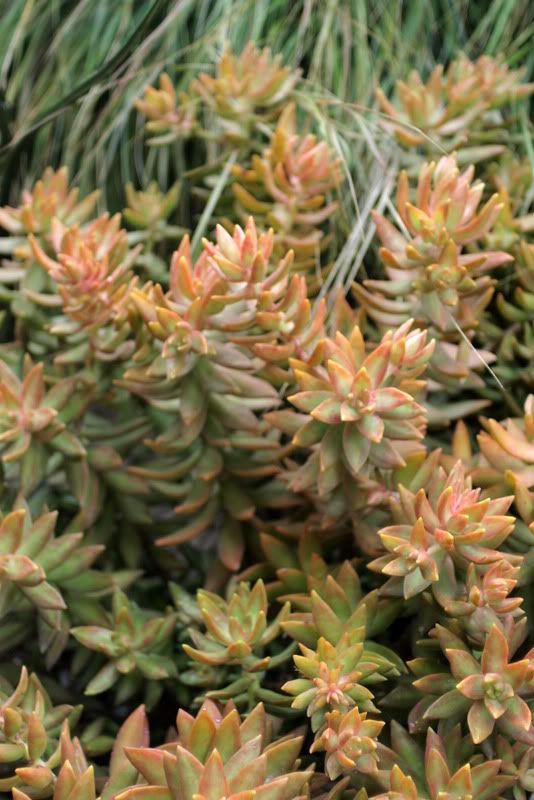
Sedum nussbaumerianum, Coppertone Stonecrop:

Photobucket

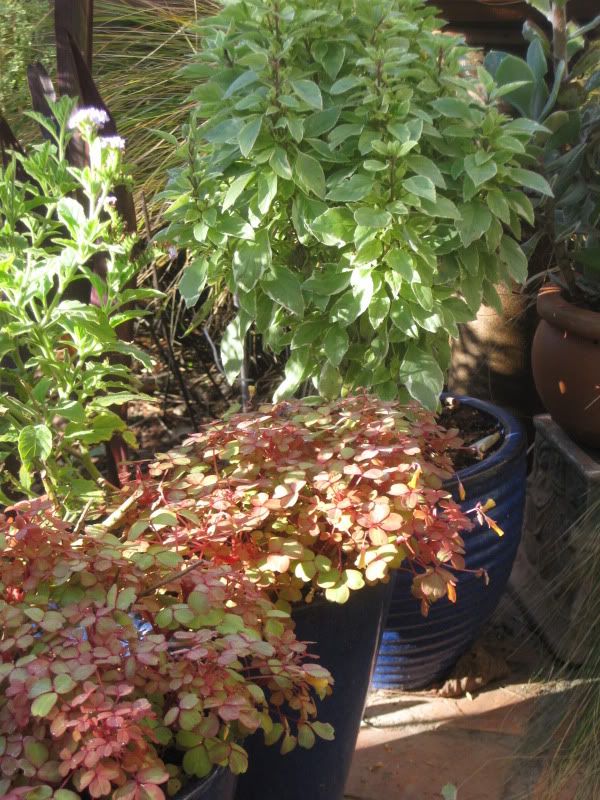
Oxalis spiralis sprawls in the cool winter months then retreats during summer. The dark burgundy form is out of frame, planted in the ground. The variegated plant is a sterile basil ‘Pesto Perpetuo.’ So pretty, I haven’t as yet snagged a leaf for the kitchen. And with tomatoes out of season, what’s the point anyway?

Photobucket

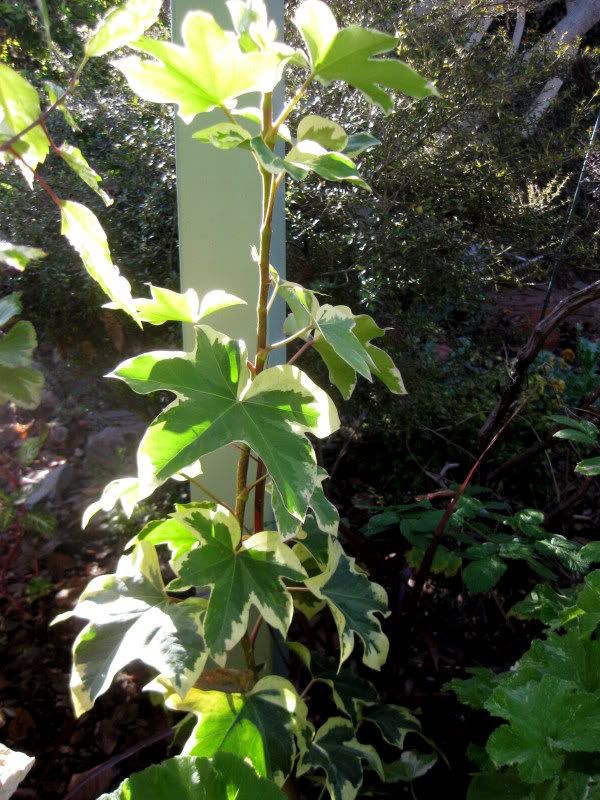
Fatshedera, bigeneric cross of, you guessed it, fatsia and hedera, picked up at the Cistus Nursery of Portland, Oregon, this past July. Lost the tag to this cultivar:

Photobucket

The round-leaved mint bush, Prostanthera. I assumed this is P. rotundifolia but find reference to the variegated mint bush as P. ovalifolia. Whatever it is, it’s a lovely, minty, shimmering shrub from Australia that I’ve grown off and on for over a decade. Tiny lavender bells appear in spring. It can get big fast:

Photobucket

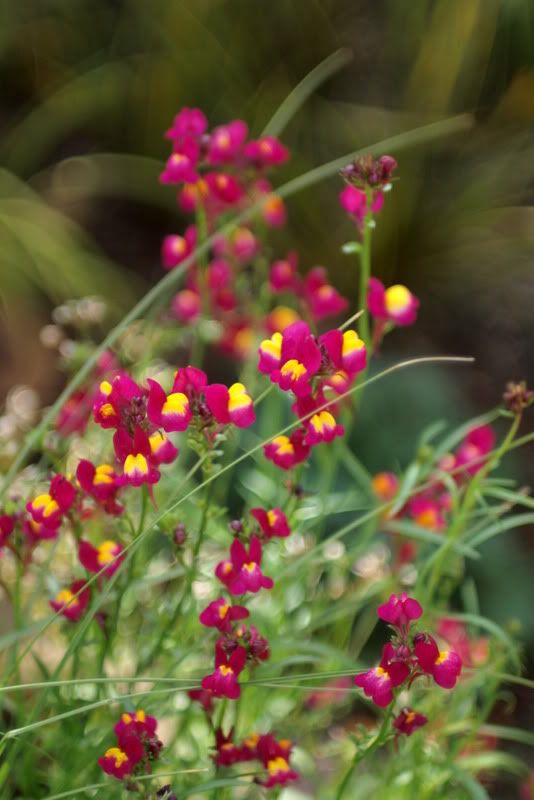
The little Moroccan toadflax likes the cool winter temps too. Linaria reticulata ‘Flamenco’:

Photobucket

Another fine-leaved shrub, the New Zealander Lophomyrtus x ralphii ‘Red Dragon’ that I keep in pots to bring to the fore when the succulence of summer’s bounty can no longer upstage their delicate beauty. (That and the fact that there’s simply no ground left in which to to plant them.)

Photobucket

Hebe ‘Quicksilver’ bringing a cross-stitch counterpoint to the solidity of a potted agave:

Photobucket

Hellebore argutifolius is in bloom, as are still the Waverly salvias and Teucrium azureum, thank goodness, for the hummers that stop by several times a day. Salvia chiapensis is awakening. The bronzy fennel backs rusty spears of Libertia peregrinans, and the white umbellifer Orlaya grandiflora has started to bloom.
Photobucket

There’s lots to look at in January. Temps are mostly in the 60s, sometimes 70s. The light is wonderful, not the “toaster oven” light of summer, as cinematographer Gordon Willis described Los Angeles light to Terry Gross in a Fresh Air interview. But I digress…

Posted in agaves, woody lilies, Plant Portraits | Tagged , , , , , , , , , , , , , | 2 Comments

The Best Zwartzkop in the Neighborhood

lives at David and Crissy’s house a few doors down the street and is obligingly in bloom this 15th of January in honor of Bloom Day :

Photobucket

Nomenclature issues for Aeonium ‘Zwartkop’ are discussed by San Marcos Growers . The dirty leaves in the San Marcos photo are usually how my dark aeoniums look, and I have to restrain myself from polishing the leaves (whereas I never have to restrain myself from wild impulses to dust things indoors). I doubt David and Crissy are surreptitiously polishing their Zwartkop, but that its high gleam is a consequence of the light, cleansing rain two days ago.

Abutilons and pelargoniums revel in the cool mid-winter temps. The pelargoniums flower better in heat, of course, but I always prefer the dramatic color brought out by colder temperatures in the leaves.

Photobucket

Yes, the rosettes of succulents do not technically belong in a Bloom Day post

Photobucket

A green aeonium, elongating into bloom, potentially a future Bloom Day post.

Photobucket

Posted in succulents | Tagged , , | Leave a comment